The Philippines is an attractive real estate market due to its strategic trade location, increasing tech and consumer industries, and growing population of younger digital nomads and expats. Because Filipino law restricts the foreign purchase of land, condominiums are the most common property option for foreign investors. With lower entry rates than many of its neighboring Asian countries, the Filipino market brings opportunities for long-term, steady returns.
This recently updated 2025 edition guide will walk you through the basic steps and important considerations for first-time buyers looking to invest in the Philippines.
12 Things to Know Before Buying a Property in the Philippines
- Can Foreigners Buy Property in the Philippines
- Best Cities and Regions to Invest
- Square Meter / Square Foot Prices
- Median Asking Prices
- Rental Yields and Rents
- Market Performance (Past and Present)
- Landlord and Tenant Laws
- Property Related Taxes
- Buying (and Selling) Costs
- Short-Term Rental Regulations
- Mortgage and Financing Options
- How to buy property in the Philippines: step-by-step
1) Can Foreigners Buy Property in the Philippines?
Yes, but with some restrictions. By law, foreign buyers cannot purchase land, but they can lease it long term (up to 99 years as of January 4, 2026). Another important restriction is that no more than 40% of the units can be foreign-owned in a condominium complex.
2) Best Regions and Cities to Invest
The Philippines presents a diverse and fast-evolving real estate landscape, ranging from dense metropolitan business districts and emerging urban centers to resort destinations and lifestyle-driven provincial cities. Each region offers different advantages depending on whether the focus is rental income, capital appreciation, tourism-driven returns, or end-user demand.
Metro Manila
As the country’s political, financial, and commercial core, Metro Manila remains the most liquid and active real estate market in the Philippines. Key districts such as Makati, Bonifacio Global City (BGC), and Ortigas are especially attractive due to their concentration of multinational companies, financial institutions, and premium residential developments. High demand from professionals, expatriates, and long-term renters supports consistent occupancy and strong rental yields, particularly for well-located condominiums near offices and transport links.
Cebu
Often referred to as the second economic hub of the Philippines, Cebu combines urban growth with a strong lifestyle appeal. Cebu City and Mandaue benefit from a robust business process outsourcing (BPO) sector, a growing middle class, and expanding infrastructure, while nearby coastal areas add tourism-driven demand. Residential properties in central business districts and mixed-use developments tend to perform well, supported by both local professionals and international buyers seeking long-term value.
Davao
Davao City stands out for its stability, improving infrastructure, and relatively affordable property prices compared to Metro Manila and Cebu. As the economic center of Mindanao, it attracts domestic migrants, professionals, and entrepreneurs. Residential developments near commercial hubs and universities see steady demand, making Davao appealing for investors focused on long-term rentals and gradual capital appreciation in a less volatile market.
Boracay and Aklan
Boracay remains one of Southeast Asia’s most recognizable island destinations, driving sustained demand for resort-style properties and short-term rentals. While regulations are stricter and supply is more controlled, well-positioned condominiums and hospitality-linked developments can offer attractive returns tied to tourism recovery and long-term brand value. This market is best suited for investors with a higher risk tolerance and a focus on lifestyle or hospitality-oriented assets.
Iloilo
Iloilo has quietly developed into a well-planned, investor-friendly city with strong governance and improving infrastructure. Growth in education, healthcare, and commercial activity has increased demand for residential properties, particularly in new business districts and master-planned communities. Compared to larger cities, Iloilo offers lower entry prices while still benefiting from steady end-user demand and long-term urban expansion.
3) Square Meter / Square Foot Prices
The square meter prices in the Philippines are moderately low compared to other Asian locations.
As of October 2025, square meter prices were as follows:
4) Median Asking Prices
Property prices in the Philippines are moderate compared to other Asian countries, but prices throughout Asia widely vary. Two-bedroom rates were as follows as of December 2025:
- Manila – $258,000
- Cebu City – $244,000
5) Rental Yields and Rents
Rental yields in the Philippines are considered moderate, averaging 5.23% overall. However, this varies by location and apartment size.
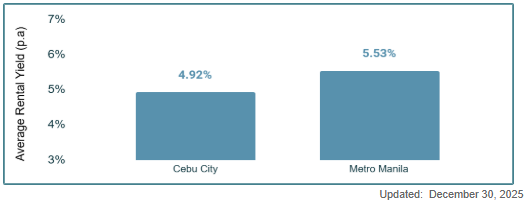
While Manila’s overall average for all apartments and neighborhoods was 5.77%, Manila City and Mandaluyong City both had yields averaging 8.8% or higher, with Mandaluyong City’s 2-bedroom apartments yielding just shy of 12%.
As of December 30, 2025, overall average yields were as follows:
- Manila – 5.53%
- Cebu City – 4.92%
Philippines' rent price index:
Data Source: Philippine Statistics Authority.
6) Market Performance (Past and Present)
The Philippine housing market boomed from 2010 to 2018 when housing prices increased by 125% (77% after adjusting for inflation). By 2019, however, the US-China trade war and a slowing domestic economy brought the housing market growth to a stop, then dropped even more in 2020 due to COVID-19, especially in Metro Manila. In fact, the Philippines was listed by Global Property Guide as one of the worst-performing housing markets in 2020.
During 2022 and 2023, Philippine housing prices began to slowly edge back upwards, but the nation also experienced high inflation. In 2024, the market slowed once again, especially in Metro Manila, where property demand has decreased and so have prices. After reducing interest rates, the economy is slowly increasing, but housing market gains remain sluggish.
Philippines' house price annual change:
Data Source: Bangko Sentral ng Pilipinas.
7) Landlord and Tenant Laws
The Philippines is judged by Global Property Guide to be pro-landlord for luxury properties and neutral for other properties. Republic Act 9653 places landlord limitations for rent increases for lower-priced properties, charging up to ₱5,000 in all regions except Metro Manila, where the limit is increased to ₱10,000. Contracts for these properties are generally verbal agreements.
Properties exceeding ₱10,000, however, have no such restrictions, giving landlords more control over rental rates and other terms.
Property taxes vary based on where the property is located, the type of property, and the square footage of the property. While acreage is another consideration, it does not usually apply for foreign investors since they cannot own land. The rate is determined by the local government’s fair market value of the property.
Foreign investors must also pay income taxes on any income gained in the country. The amount varies based on whether or not the owner is considered a non-resident foreigner (i.e, lives in the Philippines fewer than 180 days per year) and whether the property owner does other business in the country.
Foreign investors who are also considered Filipino residents or who conduct additional business in the Philippines pay income taxes based on a sliding scale. For foreign non-residents who do not have additional business in the country, rental income may be considered passive income and is taxed at a flat 25% gross rate. Whether a rental is considered a business or passive income varies on a case-by-case basis and should be discussed with a local tax attorney.
9) Buying (and Selling) Costs
Property investors should expect to pay some additional fees when buying (or selling) Filipino property, but the buyer fees are lower than in many other countries.
Buyers must pay a documentary stamp tax that equates to 1.5% of the property value. Additionally, a transfer tax of 0.5% to 0.75% is due, the amount of which depends on the local regulations. New properties priced over ₱3,600,000 may also require a 12% value added tax.
Seller fees are higher, including a capital gains tax of 6% of the zoning value, selling price, or fair market value, whichever is higher.
Here's a full breakdown:
| Transaction Costs |
| |
|
Who Pays? |
| Transfer Tax |
0.50% - 0.75% |
buyer |
| Notary Fee |
1.00% |
buyer |
| Registration Fee |
1.00% |
buyer |
| Stamp Tax |
1.50% |
seller |
| Capital Gains Tax |
6.00% |
seller |
| Real Estate Agent Fee |
3.00% - 5.00% |
seller |
| Costs Paid by Buyer |
2.50% - 2.75% |
|
| Costs Paid by Seller |
10.50% - 12.50% |
| ROUNDTRIP TRANSACTION COSTS |
13.00% - 15.25% |
| Source: Global Property Guide, PWC, KPMG |
10) Short-Term Rental Regulations
Short-term rentals are allowed throughout the Philippines, but must be registered under the Bureau of Internal Revenue (BIR), and owners must obtain a tax identification number. Owners of the property must also keep records and receipts.
Additionally, short-term rental properties must comply with condominium and HOA rules. Some do not allow short-term rentals at all, while others may require minimum stays – usually at least 30 days. HOA and condominium associations may also charge the property owner higher fees.
11) Mortgage and Financing Options
While foreign investors can potentially get a mortgage loan in the Philippines, Filipino banks tend to be more conservative than banks in some other parts of the world. This is in part due to the limitations on the types of properties foreign investors can own.
Buyers should expect to pay higher interest rates than locals, plus a 30% to 40% down payment. Obtaining a mortgage also takes longer, potentially 3 months or more. New property developers may offer financing that is easier to obtain, but these usually have higher interest rates and shorter loan terms.
12) How to Buy Property in the Philippines: Step-by-Step
- Research and Find Property: Because foreign investors cannot purchase land in the Philippines or own more than 40% of multi-unit properties (i.e., condominiums), investors are encouraged to work with a licensed real estate agent. However, looking online at popular real estate websites such as Lamudi Philippines, Property24 Philippines, and DotProperty Philippines can be a good place to start to get a feel for the market.
- Research Pricing, Yields, and Legal Restrictions: Foreign investors cannot own land, but they can lease it long-term. For this reason, condominiums are the most popular type of investment property, but no more than 40% of units in a complex can be owned by foreign investors. Additionally, not all properties can be used as short-term rentals.
Prices for Filipino property are moderate compared to other parts of Asia, and so are rental yields, which average around 5.5%. However, prices and yields vary significantly by neighborhood and property size, with a few neighborhoods yielding 8% or higher.
- Research Local Taxation and Landlord Laws: Non-residents must pay taxes on both their property and any income made in the Philippines. Property taxes vary by location. Income taxes are on a sliding scale if the owner has additional business in the Philippines (or possibly if a short-term rental is considered a business), or at a 25% gross rate if the property qualifies as passive income. It is best to work with a local tax expert to ensure taxes are paid correctly.
Landlords of luxury properties have more rights, while lower priced-properties have more
restrictions, including limits on rent increases.
- Get Legal Advice: While hiring a real estate attorney is not legally required in the Philippines, it is highly recommended. An attorney can help interpret changing laws, ensure property documents are completed correctly, and oversee due diligence, which is especially important in the Philippines.
- Make an Offer: Once the right property is found and accepted, the buyer submits a Letter of Intent (LOI) and puts down a reservation fee, which typically ranges from ₱20,000 to ₱100,000 depending on the location and the price. Unlike in many countries, the fee is not a percentage of the sales price. Your licensed agent or attorney can help determine the appropriate amount.
It is imperative to have an LOI that outlines the conditions of the agreement. This should include provisions for having the reservation fee returned if due diligence finds issues or if the property does not qualify under the 40% condominium ownership rule. It should also clearly state that the agreement is subject to loan approval.
- Secure Financing: Mortgage financing in the Philippines is usually done after the property is found and an offer has been made, rather than getting preapproval. Obtaining a mortgage may be more challenging than in some other countries. If approved, expect to pay higher interest rates than Filipino citizens, as well as a down payment of 30%-40%. The loan approval process can sometimes take as long as three months or more.
- Conduct Due Diligence: Your attorney will verify property ownership, clear titles and taxes, zoning and building compliance, and other important details to ensure that the property can be legally purchased and used as investment property by a foreign owner.
- Apply for a Philippine Tax Identification Number (TIN): The Bureau of Internal Revenue (BIR) requires a TIN in order to pay any taxes and other legal payments required. This number is needed before closing. The buyer’s legal representative can complete the application, and the approval process usually takes less than a week.
- Sign and Register the Final Paperwork: To complete the sale, both parties – or their legal representatives – must sign the Deed of Absolute Sale (DOAS). The buyer’s attorney should carefully review the DOAs before you sign to ensure everything is satisfactory and protects the buyer’s interests.
The sale is complete once the legal paperwork is notarized, all necessary final payments are made, and the final paperwork is registered.
Timeline: Expect 1-4 months from offer to completion.
Need Help?
Buying property in a foreign country can feel overwhelming, but we're here to help.
At Global Property Guide, we offer:
- Data-backed insights on property prices, rental yields, and taxes
- Country-specific legal and tax guidance through our partner network
- Pre-screened investment properties, including income-generating Airbnb units
- 1-on-1 consultations with real estate experts focused on international buyers
- Step-by-step buyer support, from due diligence to closing
Whether you're looking for your first investment in the Philippines or expanding your international portfolio, we can help you make smart, secure decisions.
Contact our team or book a free consultation to get started.