Lebanese property market remains depressed
The Lebanese property market remains depressed. There are too many new builds on the market, depressing values; Beirut seems overpriced; yields are low; demand is falling sharply; economic growth is anaemic, and construction is weak.
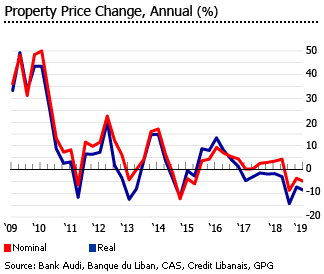
The truth is, the stimulus of the influx of Gulf money in 2008-2010 still haunts the market. House prices in several areas of Lebanon doubled from 2008 to 2012, after the oil price surge. Now those high prices seem at risk.
During the year to Q1 2019, the average value of property transaction in Lebanon fell by 5.05% to LBP 202.84 billion (US$134,676) from a year earlier, according to the Directorate of Real Estate and Cadastre. When adjusted for inflation, property prices actually declined by 8.78%. Quarter-on-quarter, property prices rose by 2.8% (1.6% inflation-adjusted) during the latest quarter.
By region:
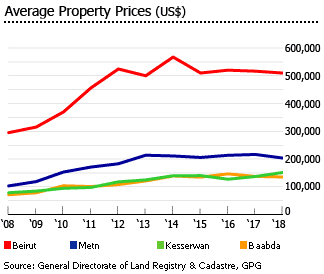
- In Beirut, which has the most expensive housing in Lebanon, property prices fell by 1.32% (-6.97% inflation-adjusted) to an average of LBP 768.5 million (US$ 509,659) during 2018.
- In Metn, property prices fell by 6.01% y-o-y (-11.38% inflation-adjusted) to LBP 306.61 million (US$ 203,345) in 2018.
- In Baabda, property prices fell by 1.35% y-o-y (-6.99% inflation-adjusted) to LBP 203.93 million (US$ 135,245) in 2018.
- In Kesserwan, property prices rose by 4.21% y-o-y (10.53% inflation-adjusted) to LBP 228.27 million (US$ 151,388) in 2018.
Demand is falling sharply. During 2018, the number and value of property sales in Lebanon fell by 17.4% and 18.3%, respectively. In fact, sales to foreigners also dropped 11% in 2018 from a year earlier – an indication of declining interest from foreign homebuyers.
“Lebanon’s real estate market has witnessed a further slump this year in all its components, with overall demand decelerating in recent months in the currently prevailing regional and domestic environment,” said Bank Audi.
Construction activity remains down. During the first two months of 2019, the area of construction permits issued plummeted by 24.4% from a year earlier, following declines of 23.11% in 2018, 4.12% in 2017, 0.86% in 2016, and 8.92% in 2015.
The housing market is expected to continue to struggle during the remainder of the year. “The most likely scenario in the near term is the continuation of the current market status quo,” said Bank Audi.
“The formation of a government might ameliorate sentiment but not trigger a massive unwinding of the sluggishness in the market. For that to occur, the investment climate would have to ameliorate tangibly in a way that encourages non-residents (especially Lebanese expatriates) to make a comeback on the local scene and residents to resume their buys. Otherwise, price discounts are likely to continue being obtained, but not necessarily increase.”
The economy expanded by a minuscule 0.25% in 2018, from y-o-y growth of 0.55% in 2017, 1.6% in 2016 and 0.4% in 2015, according to the International Monetary Fund (IMF). The Lebanese economy is projected to expand by 1.3% this year and by another 1.95% in 2020. In May 2018, Lebanon voted in their first parliamentary elections in nearly a decade.
A history of price rises
The Lebanese property market saw average annual price rises of 18% (13% inflation-adjusted) from 2009 to 2013, including a staggering 48.4% increase in 2009, before slowing sharply due to the regional political turmoil.
After falling by 12.3% (-11.7 inflation-adjusted) in 2014, property prices rose by an average of just 2% annually from 2015 to 2018. In fact when adjusted for inflation, prices have been static in the past four years.
In 2018, property prices fell by 3.7% (-7.4% inflation-adjusted) from a year earlier.
HOUSE PRICE CHANGE, ANNUAL (%) |
||
| Year | Nominal | Inflation-adjusted |
| 2009 | 48.4 | 43.6 |
| 2010 | 7.4 | 2.7 |
| 2011 | 9.8 | 6.5 |
| 2012 | 6.3 | -3.5 |
| 2013 | 16.0 | 14.7 |
| 2014 | -12.3 | -11.7 |
| 2015 | 4.4 | 8.1 |
| 2016 | 4.5 | 1.3 |
| 2017 | 3.0 | -1.9 |
| 2018 | -3.7 | -7.4 |
| Sources: Global Property Guide, Bank Audi, Banque du Liban, Credit Libanais | ||
Property sales falling sharply
The number of property sales in Lebanon fell by 17.4% y-o-y to 60,714 units in 2018, according to the Directorate of Land Registry and Cadastre, and the value of property sales transactions dropped by 18.3% y-o-y to US$8.13 billion.
North Lebanon recorded the biggest sales decline of 31.7% during 2018, followed by Baabda (-22.4%) and Metn (-22.1%), according to Bank Audi.
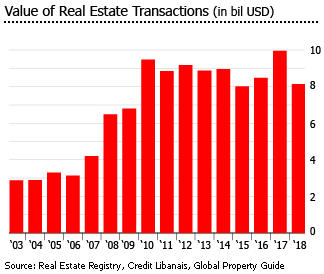
Beirut and nearby areas, including Baabda and Metn, accounted for the largest share of total market activity in 2018 with a combined 65% share.
Foreign demand falling, too
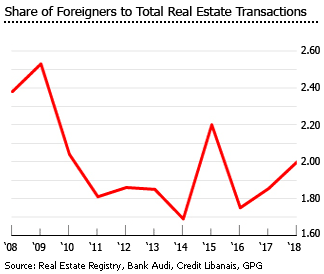
Sales to foreigners fell by 11% to 1,214 transactions in 2018 from a year earlier – an indication of their declined interest in purchasing Lebanese property amidst tough regional and domestic environment.
Foreign homebuyers represented about 2% of total property transactions in 2018, a slightly bigger share of the market compared to 1.85% in 2017 and 1.75% in 2016.
Foreign ownership of real estate property is allowed in Lebanon. Foreigners can acquire up to 3,000 square meters (sq. m) of land. Any bigger than this, a prior decree from the Council of Ministers is needed. Foreigners can only own up to 3% of the total land area of Lebanon. In the case of Beirut, foreigners can acquire up to 10% of the total area of the city.
Buyers are looking outside Beirut
Beirut’s property prices are exceptionally high, at about four times the national average. So homebuyers have been moving out from Beirut to cheaper housing. During the first eight months of 2018, Beirut accounted for only around 28.8% of the total value of property transactions, a decline from a 37.2% share in 2007, based on the figures from the Real Estate Registry.
Less expensive nearby areas, such as Baabda, Metn, and Kesserwan accounted for almost 50% of total sales in the first eight months of 2018, an increase from 47% in 2007.
Lebanon elects its first parliament since 2009
Lebanon’s religious communities maintain a watchful equilibrium. To maintain the balance of power between religious groups, the president must be a Maronite Catholic Christian, the prime minister a Sunni Muslim, the deputy prime minister an Orthodox Christian and the speaker of parliament a Shi´a Muslim. The 128 parliamentary seats are equally divided between Christian and Muslims.
The country’s economy was ravaged during the Lebanese Civil War from 1975 to 1990. From the 1990s to the early-2000s, there was an uneasy calm, with external forces and militant groups occupying different parts of the country.
In 2005, former Prime Minister Rafik Hariri was assassinated. Then in July 2006, the Israel-Hezbollah War erupted, which caused large-scale damage to Beirut, undoing much of the good work done in the post-Civil War reconstruction programme. In May 2007, the violent Nahr al-Bared conflict, the most severe internal fighting in almost two decades, exploded and ravaged some parts of the country.
Finally in May 2008, the Doha Accord marked the end of an 18-month long political crisis. Local political and security conditions improved considerably, with the Lebanese government determined to pursue reforms focused on achieving economic revival, sustainable growth and political stability.
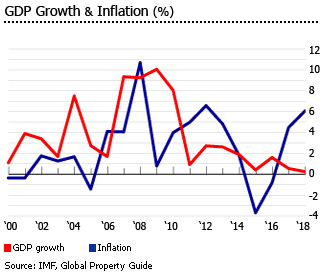
The political stability in the country helped the economy grow strongly, with an average annual GDP growth rate of 9.2% from 2007 to 2010.
However the Syrian conflict that erupted in March 2011 spilled over into Lebanon, causing deadly clashes between Sunni Muslims and Alawites in Tripoli and Beirut. Lebanon’s economy slowed sharply, with GDP growth rates of just 0.8% in 2011.
Political tensions brought down the government of Prime Minister Saad al-Hariri in January 2011. He was succeeded by Najib Mikati, whose cabinet is dominated by Hezbollah and its allies.
In June 2011, the UN issued arrest warrants for four members of Hezbollah in the murder of former PM Rafik Hariri. Hezbollah was uncooperative and refused to allow any suspects to be arrested. Tensions were exacerbated by the Arab Spring which began in December 2010.
By mid-2012, the Syrian conflict had spilled over into Lebanon in deadly clashes between Sunni Muslims and Alawites in Tripoli and Beirut. The number of Syrian refugees in Lebanon rose to over one million in April 2014, from about 700,000 people in September 2013. With a population of just 4.5 million, this means that one in every five people in the country is a Syrian refugee, placing a severe strain on the country’s resources.
General elections, due in November 2014, were put on hold due to security concerns over the conflict in Syria. The election date was moved to May 2016, after the cabinet approved a new electoral law which came into effect in June 2017. The new law is based on proportionality, dividing the country into 15 electoral districts.
In October 2016, Michel Aoun was elected by parliament, ending a political stalemate that had left Lebanon without a head of state since May 2014. Shortly after being elected, President Aoun named Saad Hariri as prime minister. He took office in December 2016.
The country faced another crisis on November 4, 2017 when Prime Minister Hariri announced his resignation while he was in Saudi Arabia, citing fears of assassination and the excessive power of Iran and Hezbollah. President Aoun and other Lebanese officials believed that Saudi Arabia had coerced Hariri, and Iran and Hezbollah saw his resignation as a plot by Saudi Arabia, the United States, and Israel to raise regional tensions. The prime minister eventually withdrew his resignation on December 5, 2017, and emphasized Lebanon’s neutrality in all regional conflicts during his speech.
In May 2018, Lebanon voted in their first parliamentary elections in nearly a decade. The voting system was changed. The number of districts was reduced. And, expatriate voting was allowed for the first time. The Islamist militant group Hezbollah made major gains while PM Hariri’s Future Party lost more than a third of its seats. The newly elected 30-member parliament is now facing the daunting task of reviving the country’s ailing economy, reducing the national debt, which stands at about 150% of GDP, and deciding on the fate of a larger number of refugees who have entered Lebanon since the Syrian civil war.
Lebanon’s sluggish economy
The economy expanded by a miniscule 0.25% in 2018, from y-o-y growth of 0.55% in 2017, 1.6% in 2016 and 0.4% in 2015. Prior to that, the economy had been growing by an annual average of 2.4% for three years, with annual GDP growth of 2.7% in 2012, 2.6% in 2013 and 1.9% in 2014, according to the IMF.
The country’s economy is partly driven by tourism. The number of tourist arrivals rose by 5.8% to 1,963,917 persons in 2018, following growth rates of 10% in 2017, 11.2% in 2016, 12.1% in 2015 and 6.3% in 2014. The rising trend seemed to continue in 2019, albeit at a slower pace, as tourist arrivals reportedly increased by 3.7% y-o-y to 375,815 persons in Q1 2019. Prior to that, tourist arrivals in the country saw an average decline of 16% per year from 2011 to 2013.
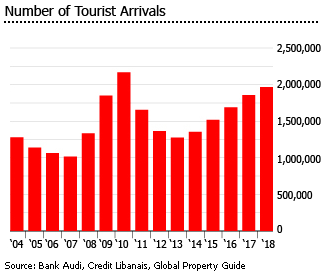
The Lebanese economy is projected to expand by 1.3% this year and by another 1.95% in 2020, according to the IMF.
Another risk - falling rental yields
Gross rental yields in Beirut have been falling. Gross rental yields on Beirut apartments now range from 3.45% to 4.5%, very significantly down from an average of 10% to 11% about six years ago. Larger apartments in Beirut have lower yields.
The continuous decline in rental yields can be attributed to the dramatic increase in house prices in recent years.
The average monthly rents in Beirut ranged from LBP3.13 million (US$2,082) for 150 sq. m. apartments, to LBP8.08 million (US$5,380) for 400 sq. m. apartments, according to the Global Property Guide’s research.
Average rents for the market as a whole are lowered by the survival of many pre-1992 contracts, creating a class of sitting tenants paying low rents, who cannot be evicted except at great cost (see Lebanon’s Landlord and Tenant Law). However this law does not affect post-1992 contracts, which are equally balanced between landlord and tenant. (The Global Property Guide’s research only covers current offers for sale and offers to rent, not pre-existing contracts).
Mortgage market continues to grow
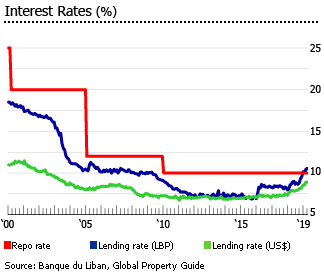
The total amount of new housing loans drawn rose by 8.8% to LBP 1.66 trillion (US$ 1.1 billion) in 2017 from a year earlier, according to the Banque du Liban. Over the same period, outstanding housing loans increased by 9.2% y-o-y to LBP 19.62 trillion (US$13.03 billion). Yet, this is a significant slowdown from annual housing loan growth of more than 28% from 2006 to 2015.
The slower growth can be partly attributed to rising interest rates. In February 2019, the average interest rate for LBP-denominated loans stood at 10.55%, up from 8.67% a year earlier. Similarly, the average interest rate for USD-denominated loans increased from 7.9% in February 2018 to 8.91% in February 2019.
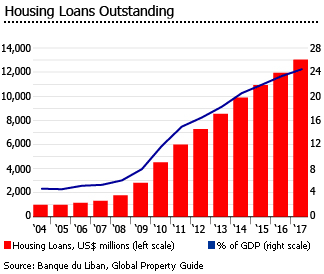
The repo rate remains at 10% in March 2019, unchanged since December 2009.
Interest rates for housing loans are usually tied to the US prime rate or LIBOR, with a fixed percentage added. The loan-to-value (LTV) ratio ranges from 50% to 85% of the appraised value or actual purchase price of the property, whichever is lower. The term period is usually from 20 to 30 years. Lebanese banks require both life and house insurance from loan applicants.
In Lebanon, buyers have traditionally paid cash, or benefited from pre-selling schemes. But starting in the mid-2000s an increasing number of banks offered mortgage loans directly to homebuyers, and the size of the Lebanese mortgage market grew rapidly from just 5.6% of GDP from 2004 to 2009, to 24.4% of GDP in 2017.
Subsidized housing loans
In January 2019, Banque du Liban has allocated LBP 790 billion (US$522.5 million) for subsidized housing loans, after they have been suspended in July 2018. Of which, LBP 490 billion (US$324.1 million) will be allocated to those who previously received approval for these loans before the program was suspended. The remaining LBP 300 billion (US$198.4 million) is allotted for new applicants.
The new loans will be given over 25 years at an interest rate of 5.92% compared to the previous program where loans have longer maturity of 30 years and lower interest rate of 3.75%.
Despite this, economist Ghazi Wazni believes that the amount allocated to the new program is insufficient to have a significant impact to the ailing real estate market. “I don’t think the LBP300 billion for housing loans in 2019 will stimulate the real estate market dramatically,” said Wazni. “We need US$800 million a year to revive the real estate sector and to allow more citizens to benefit from these subsidized loans.”
Construction activity is still down
Since the big building boom of 2008-2010, construction permits have fallen almost every year.
During the first two months of 2019, the area of construction permits issued plummeted by 24.4% to 1.35 million sq. m. from the same period last year. In 2018, new construction permits fell sharply by 23.11%, following declines of 4.12% in 2017, 0.86% in 2016, and 8.92% in 2015, based on figures from Banque Du Liban and the Order of Engineers. Of total permits, 77.4% were for the construction of residential buildings.
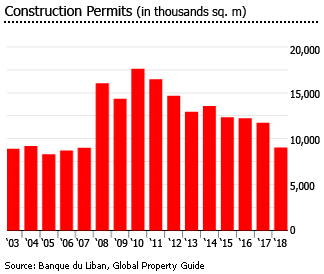
Construction activity is falling in all regions.
- In Beirut, the area of construction permits fell by more than half to 348,000 sq. m. in 2018 from a year earlier
- In North Lebanon, the area of construction permits fell by 33.7% y-o-y to 132,600 sq. m.
- In Mount Lebanon, the area of construction permits fell by 25.2% y-o-y to 4.55 million sq. m. in 2018
- In Bekaa, the area of construction permits fell by 23.4% y-o-y to 1.15 million sq. m.
- In South Lebanon, the area of construction permits dropped 6.1% y-o-y to 1.66 million sq. m.
- In Nabatieh, the area of construction permits fell by 19.4% y-o-y to 1.07 million sq. m.
Cement deliveries, a coincident indicator of the current state of the construction sector, fell by 8.7% to about 4.7 million tons in 2018 from a year earlier, according to Credit Libanais.
Major residential developments
Some major new residential developments in Lebanon:
Abdel Wahab 618
The Abdel Wahab 618 is a luxury residential complex consisting of two towers and three low-rise buildings, located in Achrafieh, Beirut. The 65,000 sq. m. property, which was launched in 2009, offers apartments ranging from 300 sq. m. to 510 sq. m. and larger duplexes. Prices of apartments start at US$ 4,000 per sq. m.
The property includes a 3,000 sq. m. of landscape and greenery, a gym, a swimming pool, and a health club. It was also located two minutes away from Sassine square and ABC Mall.
B11 Beirut
The B11 Beirut is a development launched in July 2016 by the Arabian Construction Company (ACC), featuring two low-rise and two medium-rise blocks of modern apartments. The residential project was located in Downtown Beirut and is designed by the German architect Axel Schultes.
Dreamville
Launched in August 2016 by the HEC Holding, the Dreamville project is a gated community in Metn with 176 apartments dispersed in 19 buildings. Apartment sizes offered by the project ranged from 65 sq. m. to 320 sq. m.
Dreamville features units with an overlooking view of Beirut, as well as of the Mediterranean Sea. It also includes a building dedicated for visitors parking (80), pharmacy, mini-market, and a club house.
Medyar
The Medyar project is a large-sized gated community in Damour with an overall area spanning 2.1 million sq. m. It was formally launched at the DREAM exposition in July 2016, although the infrastructure already began in 2013. The project has over 200 plots for sale, which will be divided into various types of housing units such as villas, townhouses, and apartments.
The centerpiece of Medyar will be the "Old City", which will include cafes, shops, restaurants, hotels, sport courts and swimming pools, and a cinema complex. Other amenities of the project consist of educational, medical, and hospitality facilities, as well as a country club with a golf course.
The starting price for the apartment building and townhouse zones range from US$ 400 to US$ 600 per sq. m. Villa prices are expected to be higher.
Elmirador de Terbol
The Elmirador de Terbol is another large-sized gated community developed by Ahmad Alameddine and Mohamad Malass, which is covering an overall area of 735,000 sq. m. and was divided into two phases. The US$ 100 million worth project located in Terbol has already completed its first phase, which includes 330 villas with sizes ranging from 220 to 580 sq. m. Villas are being sold at US$ 1,200 to US$ 1,500 per sq. m.
The second phase covers a dedicated area of 60,000 sq. m., which will house several amenities such as a mall, a school, restaurants, a community center, an amphitheater, and a hotel. The project is expected to consist of 720 to 730 villas.
KYE Beachfront Resort
This 200,000 sq. m. beachfront resort in Tabarja has over 700 chalets, which are being sold in phases. The chalets on sale range from 45 to 85 sq. m. and has a starting price of US$ 4,800 per sq. m. The project provides amenities and entertainment facilities such as a 3,000 sq. m. gym and spa, 10 sports courts, a waterpark, an a yachting marina.
Red Rock
The Red Rock development is a project of Demco Properties that covers about 500,000 sq. m. of land near Faqra. The project is expected to construct about 500 chalets and will be divided into two phases. The first phase, which consists of 212 chalets, is currently underway.
Chalets’ sizes range from 40 to 150 sq. m., and are priced starting at US$ 2,800 per sq. m. Aside from keeping forests unspoiled, the developer also intends to build a bio-farm, which would also serve as an educational attraction for school kids.
Sources:
- Lebanon Real Estate Sector (Bank Audi): http://www.bankaudigroup.com/GroupWebsite/openAudiFile1.aspx?id=3941
- Lebanon Economic Report (Bank Audi): http://www.bankaudigroup.com/GroupWebsite/openAudiFile1.aspx?id=4071
- World Economic Outlook Database (International Monetary Fund): https://www.imf.org/external/pubs/ft/weo/2019/01/weodata/weoselgr.aspx
- Repo Rate (Banque du Liban): http://www.bdl.gov.lb/statistics/table.php?name=t5271-6
- Commercial Banks – LBP: Discount and Loans (Weighted Average) (Banque du Liban): http://www.bdl.gov.lb/webroot/statistics/table.php?name=t5272-3
- Commercial Banks – US$: Discount and Loans (Weighted Average) (Banque du Liban): http://www.bdl.gov.lb/statistics/table.php?name=t5273-1
- Construction Permits (Banque du Liban): http://www.bdl.gov.lb/webroot/statistics/table.php?name=t51-11
- Lebanon’s residential price rises have continued (Global Property Guide): https://www.globalpropertyguide.com/Middle-East/Lebanon/Rental-Yields
- Weekly Market Watch Issue No. 629 (Credit Libanais): https://www.creditlibanais.com.lb/Content/Uploads/LastEconomicAndCapitalResearch/190119104826193.pdf
- Weekly Market Watch Issue No. 642 (Credit Libanais): https://www.creditlibanais.com.lb/Content/Uploads/LastEconomicAndCapitalResearch/190425080852046.pdf
- Lebanon’s central bank gives new subsidized housing loans (XinhuaNet): http://www.xinhuanet.com/english/2019-01/31/c_137787932.htm
- Lebanon profile – Timeline (BBC News): https://www.bbc.com/news/world-middle-east-14649284
- Lebanon elects its first new parliament since 2009 (BBC News): https://www.bbc.com/news/world-middle-east-44020061