Hong Kong's Residential Property Market Analysis 2026
Hong Kong’s residential property market is now firmly in recovery mode, with prices climbing for nine consecutive months through February 2026 and transaction volumes surging at the strongest pace in nearly five years. The rebound is being driven by improving economic conditions, the removal of all market-cooling measures, easing interest rates, and renewed buying interest from Mainland Chinese homebuyers.
This extended overview from the Global Property Guide provides a comprehensive assessment of Hong Kong’s housing market, examining its key characteristics while offering a closer look at recent developments and longer-term structural trends shaping the sector.
Table of Contents
- Housing Market Snapshot
- Historic Perspective
- Demand Highlights
- Supply Highlights
- Rental Market
- Mortgage Market
- Socio-Economic Context
Housing Market Snapshot
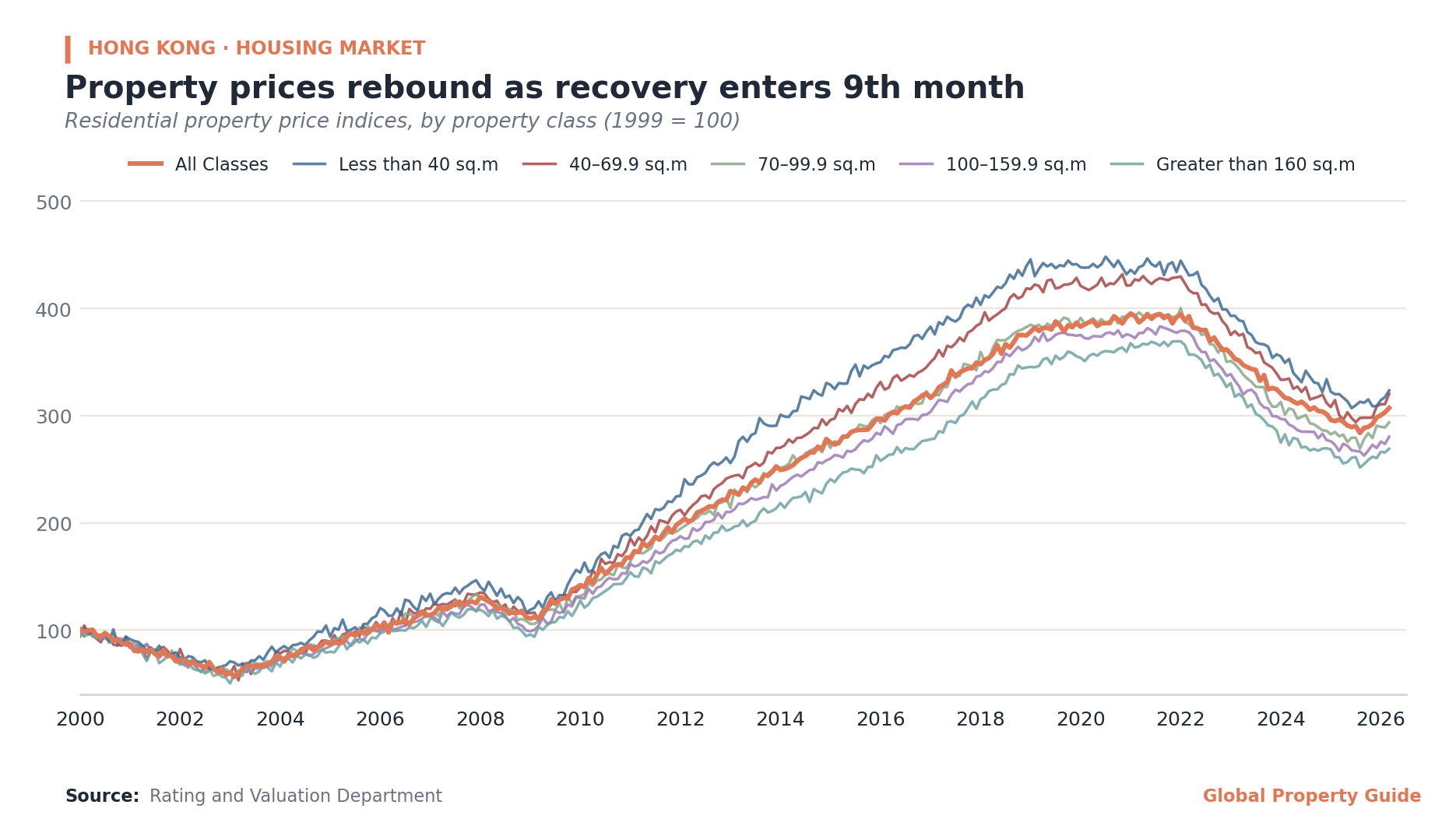
Hong Kong's residential property price index has now risen for nine consecutive months through February 2026, climbing 1.6% month-on-month in February alone, according to data released by the Rating and Valuation Department (RVD). Cumulative gains since the trough have reached approximately 8% for second-hand homes, bringing the official price index to its highest level in 22 months. Year-to-date gains range from 2.6% to 7.7% depending on the index and segment.
The recovery has been broad-based. Quarterly figures from the Bank for International Settlements show Hong Kong's residential property price index reached 197.34 points in Q4 2025, up from 192.24 points in Q3 2025. The Q4 2025 reading is up by approximately 2.7% quarter-on-quarter and snaps a long downtrend that ran from early 2022.
Hong Kong's house price annual change:
"Housing prices have bottomed out, and the outlook for 2026 is cautiously optimistic. We expect capital values to rise by about 5 per cent, while luxury residential values will remain broadly flat. Luxury rents are projected to increase by up to 5 per cent," said Joseph Tsang Hon-ping, chairman of JLL in Hong Kong.
Cushman & Wakefield's data confirms the trend: overall mass-market home prices rose by around 5% in Q1 2026, and the firm now expects full-year residential transaction numbers to reach 65,000 to 70,000 units. "Despite ongoing geopolitical tensions in the Middle East, Hong Kong's residential market continued to perform resiliently, with both primary and secondary market transactions recording sustained growth. Total residential transaction numbers in Q1 rose by 9% q-o-q and 53% y-o-y. Our Verbal Enquiry index has now risen for three consecutive months, reflecting sustained positive sentiment in the Hong Kong residential market," said John Siu, Managing Director of Cushman & Wakefield Hong Kong, in April 2026.
Variations in price movements per property size and region (October 2025 data, the most recent monthly breakdown by class):
- Apartments smaller than 40 sq. m: the prices fell slightly by 0.6% y-o-y in October 2025, to an average of HK$131,305 (US$16,885) per square meter (sqm). It is a deceleration from the year-over-year price fall of 7.8% in October 2024.
- 40-69.9 sq. m. apartments: prices were down by 2.2% y-o-y to an average of HK$132,729 (US$17,069) per sqm in October 2025. It is an improvement from the 12.7% y-o-y contraction seen in October 2024.
- 70-99.9 sq. m. apartments: prices were up by 9.4% in October 2025 from the same period last year, to reach an average of HK$171,697 (US$22,080) per sqm. It was a sharp turnaround from the prior year's 9.8% price fall.
- 100-159.9 sq. m. apartments: prices fell by a modest 4.8% y-o-y to an average of HK$197,080 (US$25,344) per sqm in October 2025. It was compared to the strong growth of 20.6% recorded in the same period last year.
- Apartments with sizes bigger than 160 sq. m: prices dropped by a huge 21.5% y-o-y to HK$210,509 (US$27,071) per sqm in October 2025. This is in contrast to the y-o-y price increase of 14.3% seen in October 2024.
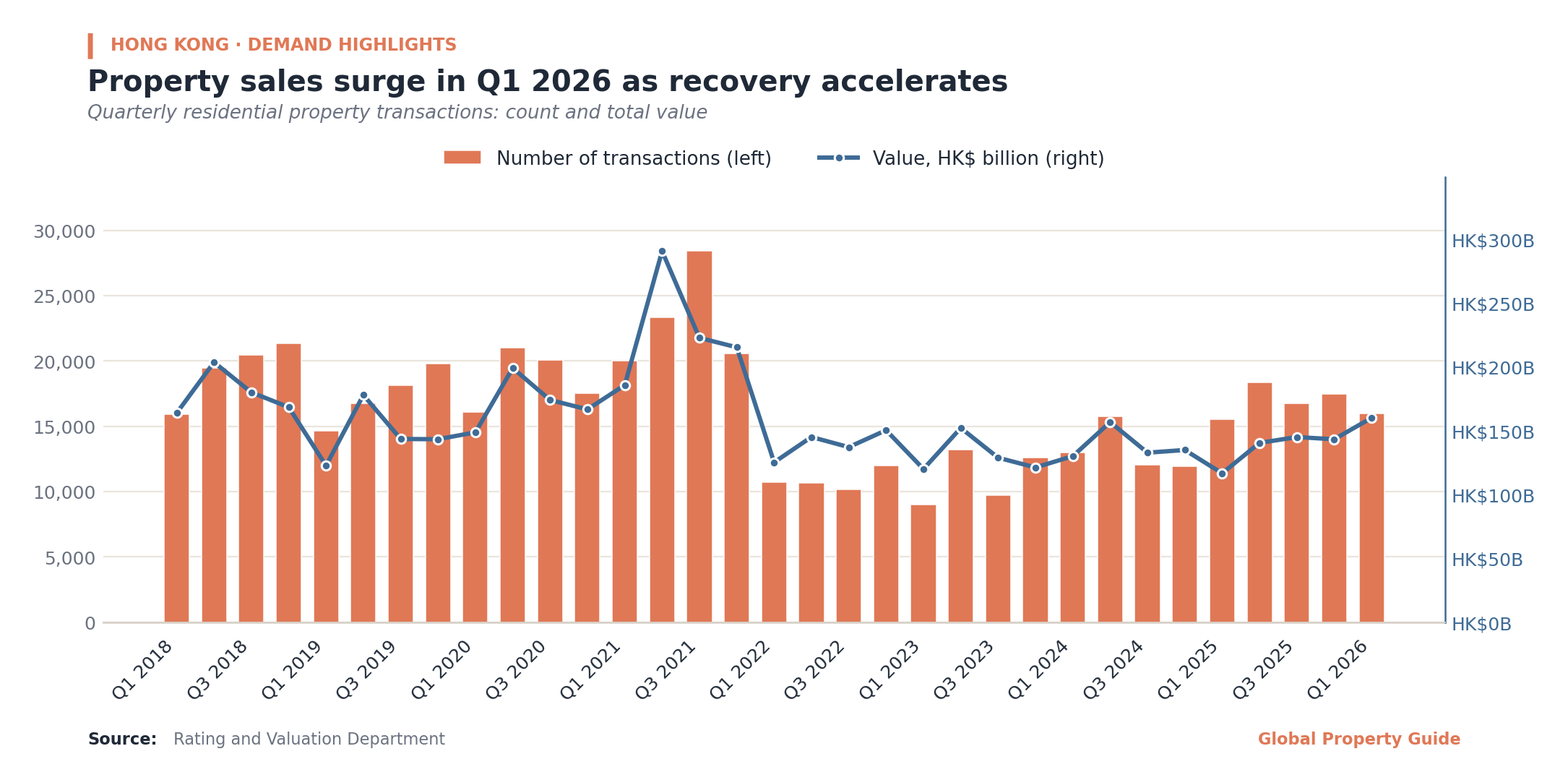
Demand has surged into 2026. Q1 2026 residential sale-and-purchase agreements are estimated at 13,500 to 18,650 units, up 10% to 20% quarter-on-quarter and as much as 53% year-on-year in some agency reports. Primary sales continue to lead the rebound, while secondary activity benefits from improved buyer sentiment, stable borrowing costs, and supportive government policies.
Looking back at the 2025 calendar year, the total number of property transactions - including primary and secondary sales - rose by 23.5% in 2024 and continued strongly into 2025. In the first ten months of 2025, transactions rose by 20.3% y-o-y to 51,361 units, with total sales volume increasing by 14.4% y-o-y to HK$416.94 billion (US$53.62 billion).
As such, residential construction activity remains active, although the pipeline is tightening. According to RVD preliminary data, private residential completions totalled approximately 18,450 units in 2025, down 24% from the 24,261 units completed in 2024. Forecasts point to further contraction: approximately 16,980 units in 2026 and 15,360 in 2027. This tightening supply pipeline supports longer-term price resilience.
Despite this, Hong Kong continues to suffer a chronic housing shortage - a problem that has dragged on for over two decades.
| AVERAGE HOUSE PRICES, OCTOBER 2025 | ||||||
| Property size | Average prices (per sqm) | Year-on-year change | ||||
| Hong Kong | Kowloon | New Territories | Hong Kong | Kowloon | New Territories | |
| HKD (USD) | HKD (USD) | HKD (USD) | % | % | % | |
| Less than 40 sqm | 131,305 ($16,885) |
118,374 ($15,223) |
109,384 ($14,066) |
-0.6 | 2.9 | -1.9 |
| 40 sqm - 69.9 sqm | 132,729 ($17,069) |
123,852 ($15,927) |
105,977 ($13,628) |
-2.2 | -1.9 | -3.0 |
| 70 sqm - 99.9 sqm | 171,697 ($22,080) |
149,679 ($19,248) |
117,074 ($15,055) |
9.4 | -3.1 | -0.6 |
| 100 sqm - 159.9 sqm | 197,080 ($25,344) |
171,940 ($22,111) |
106,459 ($13,690) |
-4.8 | -0.7 | -5.2 |
| Greater than 160 sqm | 210,509 ($27,071) |
224,714 ($28,898) |
103,323 ($13,287) |
-21.5 | -13.0 | 0.8 |
| Sources: Rating and Valuation Department (RVD), Global Property Guide | ||||||
From 2008 to 2013, Hong Kong's dwelling prices skyrocketed by 134% (95.7% inflation-adjusted), driven by a flood of money in the wake of the global financial crisis.
The market slowed in the first half of 2014, but bounced back in the second half, with prices rising by 13.6% in Q4 2014, 19.6% in Q1 2015, 20.4% in Q2 2015, and 15% in Q3 2015.
After a brief housing market slowdown, house prices surged again by 41.5% (35.5% inflation-adjusted) from H2 2016 to H1 2018.
The housing market slowed from the end of 2018 until the first half of 2019 due to macroeconomic uncertainties and social unrest. After a short-lived recovery in the second half of 2019, the housing market struggled again in 2020 due to pandemic-related travel restrictions and lockdown measures imposed worldwide. Then in 2022, things got worse, with house prices plunging by 15% (-16.7 inflation-adjusted), following a modest increase of 3.7% in 2021 and a meager growth of 0.2% in 2020.
The housing market remained depressed in 2023 and 2024, with house prices falling further by 7% (-9.2% inflation-adjusted) in 2023 and by another 7.1% (-8.4% inflation-adjusted) in 2024. The downtrend continued into the first half of 2025, with prices falling by an estimated 2.5% for the full year of 2025. However, the market reached its trough in mid-2025 and has reversed sharply since June 2025 — by February 2026, prices had risen for nine consecutive months, with cumulative gains of approximately 8% off the bottom. Q1 2026 transaction volumes were up 53% year-on-year per Cushman & Wakefield data, marking the strongest quarterly demand in four years.
Overall, Hong Kong's service-oriented economy expanded robustly in Q1 2026, with real GDP rising 5.9% year-on-year - the strongest quarterly expansion in nearly five years. This was up from a revised 4.0% growth in Q4 2025 (originally estimated at 3.8%). The acceleration was driven by a powerful rebound in external trade, resilient domestic demand, and solid growth in visitor arrivals.
"The Hong Kong economy expanded robustly in the first quarter of 2026," said the Hong Kong government. "Looking ahead, Hong Kong's economic growth outlook remains positive, underpinned by strong global demand for artificial intelligence (AI)-related electronics, sustained growth in visitor arrivals, and robust cross-boundary financial activities."
Historic Perspective:
Hong Kong still most unaffordable, but bubble risks ease
Hong Kong's housing boom in the past decades has been propelled by a combination of stringent government regulations on development, historically low interest rates, and currency stability, while the supply of land, which the government controls, continues to diminish.
Hong Kong's currency peg to the dollar kept borrowing costs near record lows, fueling continued property demand.
| HOUSE PRICE INDEX, Y-O-Y CHANGE (%) | ||
| Year | Nominal | Inflation-adjusted |
| 2010 | 21.0% | 17.5% |
| 2011 | 11.1% | 5.1% |
| 2012 | 25.7% | 21.3% |
| 2013 | 7.7% | 3.2% |
| 2014 | 13.6% | 8.3% |
| 2015 | 2.4% | 0.1% |
| 2016 | 7.9% | 6.6% |
| 2017 | 14.7% | 12.8% |
| 2018 | 1.9% | -0.6% |
| 2019 | 5.5% | 2.6% |
| 2020 | 0.2% | 1.1% |
| 2021 | 3.7% | 1.3% |
| 2022 | -15.0% | -16.7% |
| 2023 | -7.0% | -9.2% |
| 2024 | -7.1% | -8.4% |
| 2025 | 2.0% | 0.8% |
| Sources: Rating and Valuation Department, Global Property Guide | ||
Despite improved affordability because of the recent decline in house prices, Hong Kong's property market remains the world's most unaffordable for the fourteenth year in a row, according to the Demographia International Housing Affordability Survey 2025. Average home prices were 14.4 times the gross annual median household income in 2024, down from 16.7 times in 2023, 18.8 times in 2022, and 20.7 times three years ago. With prices falling a further 2.5% over 2025 before bottoming out in mid-year, affordability is likely to have improved marginally further before the recent recovery began pushing the multiple back up in late 2025 and Q1 2026.
"Hong Kong has been the least affordable market in Demographia International Housing Affordability for the past 14 years since its inclusion. However, in recent years, there have been material improvements. The 2024 Hong Kong median multiple of 14.4 improved from 16.7 in 2023. This is an even greater improvement than Hong Kong's pre-pandemic 20.8 in 2019," said the Demographia report.
"China's central government has given Hong Kong a clear responsibility to improve housing affordability and increase house sizes, which are among the smallest in the world."
Similarly, in Mercer's 2024 Cost of Living Survey, Hong Kong was ranked as the world's most expensive city for expatriates to live in, followed by Singapore, Zurich, and Geneva.
Likewise, the 2025 UBS Global Real Estate Bubble Index ranked Hong Kong as the least affordable city, with approximately 14 years of income needed to purchase a 60 sqm apartment. However, the study noted that Hong Kong, along with Toronto, recorded the largest declines in bubble-risk scores, now falling into low bubble-risk territory due to recent sharp declines in house prices.
"Sales activity has picked up, supported by changes to mortgage insurance, property stamp duty easing, lower rates, and most importantly, lower home prices. Real home prices started to stabilize after falling nearly 28% below 2021 levels, matching those last seen in 2011 in inflation-adjusted terms," said the UBS report. The trajectory since that September 2025 publication has been more positive than UBS expected: prices began rising consistently from June 2025 onwards, with the 8% cumulative rebound by February 2026 already exceeding the "flat to slightly negative" forecast.
UBS economist William Deng has since maintained a constructive view, noting in May 2026 that Hong Kong GDP growth for 2026 will reach 3.3%, "supported by export growth in artificial intelligence and related sectors, a revival in housing transactions and higher home prices, increased fiscal revenues from stamp duty, and stabilization and gradual recovery in consumption."
Demand Highlights:
Property demand surges in early 2026
Q1 2026 residential sale-and-purchase agreements are estimated at 13,500 to 18,650 units, up 10% to 20% quarter-on-quarter and as much as 53% year-on-year in some agency reports. Primary sales continue to lead the rebound, while secondary activity benefits from improved buyer sentiment, stable borrowing costs, and supportive government policies. Ultra-luxury segments have cooled modestly following the February 2026 stamp duty increase on properties above HK$100 million (from 4.25% to 6.5%).
For full-year 2025, the total number of property transactions - including primary and secondary sales - is estimated to have risen strongly, following a 20.3% y-o-y increase to 51,361 units in the first ten months of 2025, a strong growth of 23.5% in 2024, and annual declines of 4.5% in 2023 and 39.4% in 2022, based on figures released by RVD. Likewise, total sales volume increased by 14.4% y-o-y to HK$416.94 billion (US$53.62 billion) in Jan-Oct 2025, after rising by 16.7% in 2024 and falling by 4.5% in 2023 and 44.4% in 2022.
As a result of the government lifting all market cooling measures earlier in 2024, Mainland Chinese homebuyers flocked to the Hong Kong property market in recent months, driving transaction levels to increase again.
Though there were wide variations in sales movements in the primary and secondary markets in the first ten months of 2025:
- Primary market property sales were up strongly by 25.5% y-o-y to 16,979 units, following a spectacular growth of 57.3% in 2024, a modest increase of 4.2% in 2023, and a huge contraction of 41.6% in 2022, based on data from RVD. Likewise, total transaction values increased by 17.8% y-o-y to HK$178 billion (US$22.89 billion), following annual growth of 51.3% in 2024 and 16.3% in 2023 and a huge fall of 52.5% three years ago.
- Secondary market property sales were up by 17.9% y-o-y to 34,382 units in Jan-Oct 2025, following an annual growth of 12.2% in 2024 and declines of 7.2% in 2023 and 38.7% in 2022. Similarly, transaction values increased by 12% y-o-y to HK$238.94 billion (US$30.73 billion), following annual contractions of 0.1% in 2024, 12.2% in 2023, and 40.8% three years ago.
This is in line with the recent figures released by the Land Registry, which showed that a total of 71,703 properties changed hands in Hong Kong in the first eleven months of 2025, up strongly by 14.8% compared to the same period last year. This follows an annual growth of 17.1% in the whole year of 2024 and a decline of 2.7% in 2023. Similarly, the total value of property transactions increased by 11.8% y-o-y to HK$549.24 billion (US$70.63 billion) over the same period, following a full-year growth of 11.8% in 2024 and a contraction of 13.8% in 2023.
Demand for residential property in Hong Kong is expected to strengthen further in the coming months, supported by the strong economy, stable borrowing costs, and a gradual improvement in market sentiment.
Property market restrictions relaxed
In February 2026, the government revised stamp duty on ultra-luxury properties, raising the rate on properties above HK$100 million from 4.25% to 6.5%. This change has cooled the very top end of the market while leaving the broader recovery intact.
Effective 17 September 2025, the government revised the New Capital Investment Entrant Scheme (New CIES), lowering the minimum residential property price eligible for investment from HK$50 million (US$6.43 million) to HK$30 million (US$3.86 million) and raising the maximum property investment that could count toward the scheme from HK$10 million (US$1.28 million) to HK$15 million (US$1.93 million). The changes aim to attract more high-net-worth investors and enhance liquidity in the housing market.
Also in May 2025, the Stamp Duty (Amendment) Bill 2025 was enacted, which effectively increases the maximum property value subject to stamp duty of HK$100 (US$13) from HK$3 million (US$385,792) to HK$4 million (US$514,389). This change, part of the 2025-26 Budget, helps make buying lower-value properties easier. The adjustment applies to transactions executed on or after February 26, 2025.
"Based on property transaction data of 2024-25, we estimate that the measure will benefit approximately 15 per cent of property transactions, with government revenue reduced by about $400 million annually," said a government spokesperson.
In October 2024, with effects extending into 2025, the Hong Kong Monetary Authority (HKMA) relaxed mortgage lending rules by removing most countercyclical macroprudential measures. The changes effectively standardized the maximum loan-to-value ratio at 70% and raised the debt-servicing ratio cap to 50% for most residential mortgages, easing financing conditions and supporting housing demand amid a prolonged market downturn.
Earlier, Hong Kong removed all extra stamp duties in February 2024 to revive the struggling housing market, following pressure to lift long-standing housing market cooling measures, according to finance chief Paul Chan.
The decade-old property cooling measures have been lifted, including the Buyer's Stamp Duty targeting non-permanent residents, the New Residential Stamp Duty for second-time buyers, and the Special Stamp Duty aimed at homeowners who sold their property within two years.
"After prudent consideration of the overall current situation, we decide to cancel all demand side management measures for residential properties with immediate effect, that is, no Special Stamp Duty, Buyer's Stamp Duty, or New Residential Stamp Duty needs to be paid for any residential property transactions starting from today," said Chan. "We consider that the relevant measures are no longer necessary amidst the current economic and market conditions."
Two years on, the policy has clearly worked: transaction volumes have rebounded from a multi-year trough, with Q1 2026 sales up 53% year-on-year. JLL analysts have projected that developer inventory, which required 101.6 months and 67.4 months to clear in 2023 and 2024, respectively, will return to normal levels by the end of 2026.
In October 2023, Chief Executive John Lee announced a partial easing of extra stamp duties - the first time that the property cooling measures were relaxed in over a decade. Among the property market curbs relaxed:
- The Buyer's Stamp Duty (BSD) and the New Residential Stamp Duty (NRSD) were halved from 15% to 7.5%.
- The Special Stamp Duty (SSD) - equivalent to 10% of the property price - that was previously imposed on transactions involving property held for less than three years will now only apply to transactions for property held for less than two years.
- All stamp duties on property purchases by newly-arrived foreign talents in Hong Kong are suspended, but it is subject to the new residents obtaining permanent residency.
- Stamp duties paid by second-home buyers and non-locals were also halved from a maximum of 30% to 15%.
Also in September 2022, the HKMA relaxed its stress-test requirements for new mortgage borrowers by 100 basis points, effectively making the test easier to pass. The recent move came amidst falling property demand, after homebuyers saw their purchasing power fall by HK$1 million (US$128,597) since January 2022, following increases in both HIBOR and banks' prime rates.
Several rounds of market-cooling measures
Before the recent relaxation of property curbs, the HK government implemented several rounds of housing market-cooling measures in the past years to reduce speculative buying and regulate house price growth.
To discourage developers from hoarding, in June 2018, Carrie Lam introduced a vacancy tax on unsold homes that are not leased or have remained unoccupied for six months after receiving an occupation permit. The tax rate is two times the rental income or 5% of the home's value.
Aside from the tax, the government also allocated nine plots of land, including three in the prime Kai Tak district, for public housing.
In addition, the HKMA imposed new restrictions on bank lending to property developers in May 2017, restricting loans to property developers to a maximum of 40% of a site's value, replacing the earlier limit of 50%. Also, the number of loans allowed for residential property with a value less than HK$10 million (US$1.28 million) was reduced from 60% to 50%, and those with a value exceeding HK$10 million (US$1.28 million) were also cut from 50% to 40%.
In addition, a 30-person Land Supply Task Force was set up to consider long-term solutions to Hong Kong's housing crisis, given the outcry about 'coffin homes'.
In recent years, Hong Kong's government has leaned against property price rises:
- In November 2010, the government imposed a 'flip tax' of 15% on properties resold within six months (though in May 2014 the rule was somewhat relaxed), and doubled stamp duties to 8.5% on properties worth HK$20 million (US$2.55 million) or more.
- On October 26, 2012, the government imposed a 15% extra tax on property purchases made by foreigners.
- In February 2013, the government doubled the stamp duty on all property transactions worth more than HK$2 million (US$257,195), though again, this measure ended in May 2014.
- In April 2013, the Residential Properties (First-hand Sales) Ordinance to shield buyers from dishonest sales practices came into full effect.
- In February 2015, the government required buyers of self-used residential properties valued under HK$7 million (US$900,181) to make larger down payments.
- In November 2016, the government raised stamp duties for all property transactions to 15%, except for first-time homebuyers who are charged just 4.25%. However, house price rises continued to accelerate, amidst a surge in the number of multiple home purchases on one single transaction as investors take advantage of lower tax rates.
- To close the loophole, the government also announced that first-time homebuyers acquiring more than one property in a single contract will be charged the same 15% stamp duty that applies to purchases of a second property starting April 2017.
Supply Highlights:
Construction pipeline tightens after 2024 surge
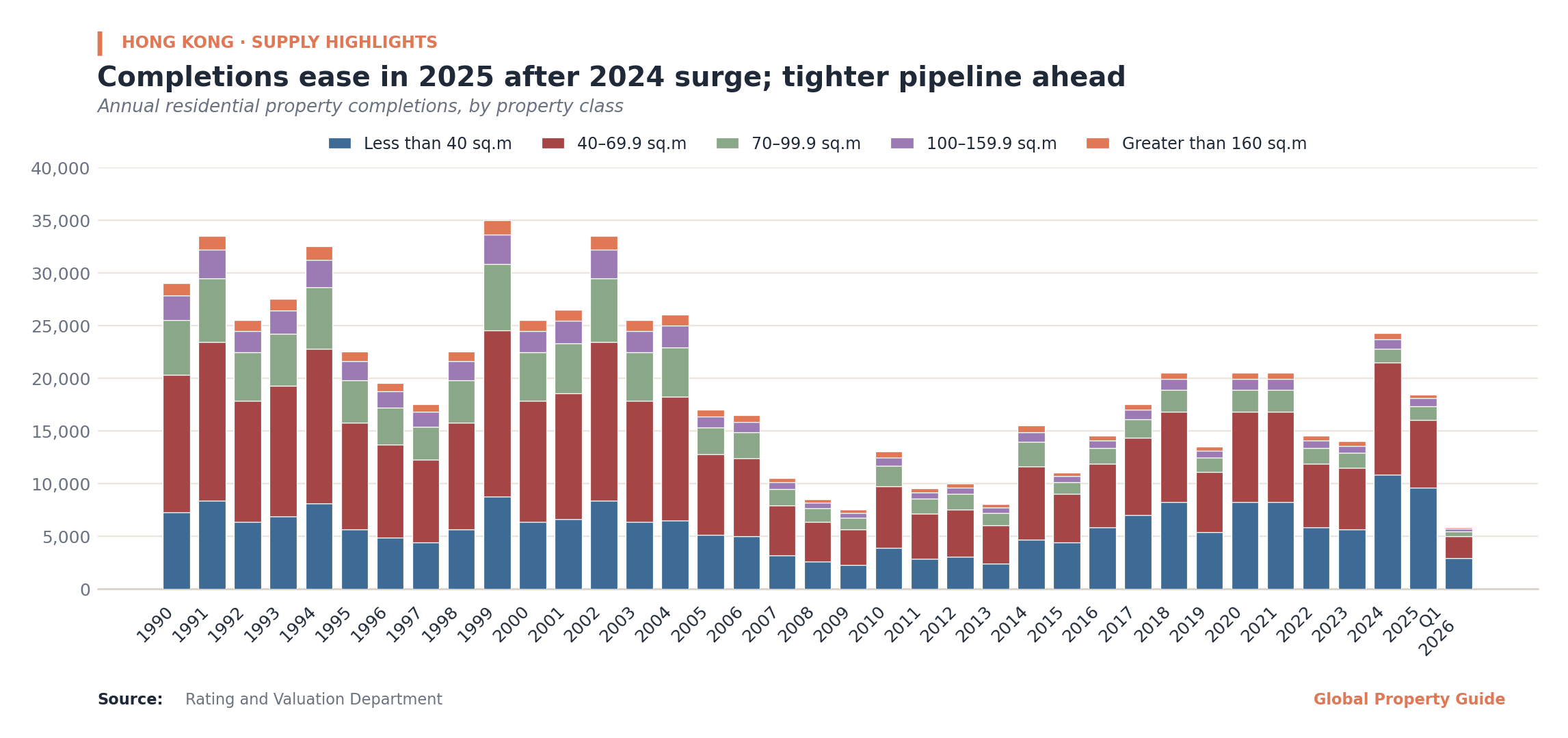
According to RVD preliminary data, private residential completions totalled approximately 18,450 units in 2025, down 24% from the 24,261 units completed in 2024. Forecasts point to further contraction: approximately 16,980 units in 2026 and 15,360 in 2027. Unsold completed inventory currently stands at around 21,000 to 23,000 units, and private home vacancy rates have dipped to about 4.3%, reflecting steady absorption.
For 2024, residential completions soared by 75.1% y-o-y to 24,261 units, a sharp improvement from an annual decline of 34.6% in 2023, according to figures released by RVD.
The New Territories and Kowloon accounted for 48% and 45% of the total 2024 completions, respectively. The remaining 7% were from Hong Kong Island. More specifically, the largest share came from Kowloon City at 33%, followed by Yuen Long and Tuen Mun at 17% each.
By property class for 2024:
- Class A completions (properties with an area of 40 sqm and below) surged by 38.3% y-o-y to 10,794 units, following a contraction of 21% in the preceding year.
- Class B completions (40 to 69.9 sqm) rose by a whopping 129.4% y-o-y to 10,705 units, in contrast to an annual fall of 39.1% in 2023.
- Class C completions (70 to 99.9 sqm) increased by 21.1% y-o-y to 1,284 units, in stark contrast to the 48.2% fall recorded in 2022.
- Class D completions (100 to 159.9 sqm) increased by nearly six times from 157 units to 913 units in 2024, a sharp turnaround from an annual decline of 85.1% in the prior year.
- Class E completions (160 sqm and above) rose by about 3.5 times from 162 units a year earlier to 565 units in 2024, in contrast to a decline of 68.9% in 2023.
This tightening supply pipeline supports longer-term price resilience. Land disposal trends indicate even tighter supply conditions emerging in 2027-28.
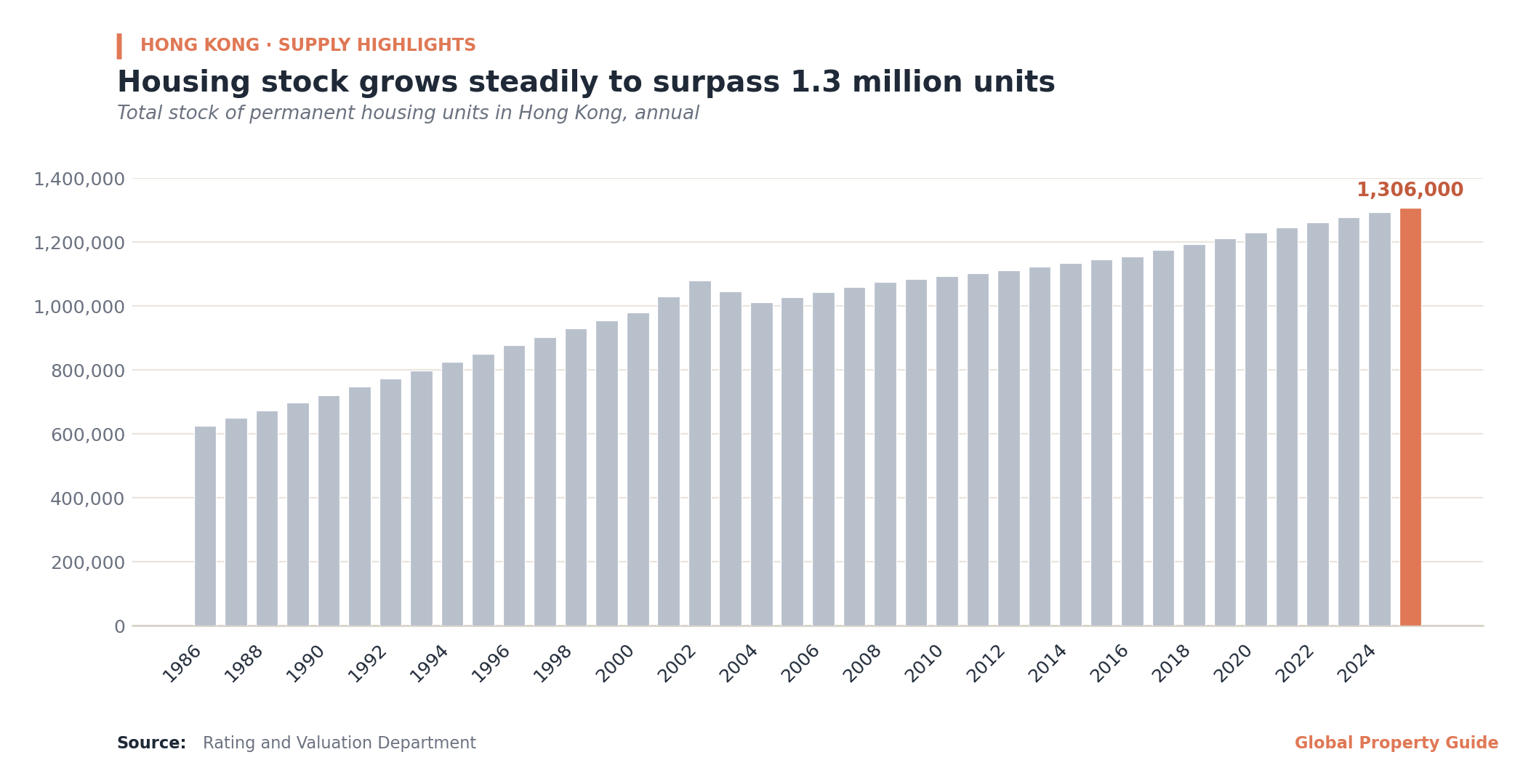
The stock of flats in Hong Kong totaled approximately 1,306,000 units in 2025, up by about 1.1% from 1,291,956 units in 2024, according to the Housing in Figures 2025 report released by the Housing Bureau and RVD updates. Of these, approximately 1,330,000 units are public permanent housing, while the remaining roughly 1,750,000 units are private housing (combined permanent housing total of about 3,080,000 units in 2025).
Tackling Hong Kong's longstanding housing shortage
Increasing supply is the key. "We are looking at a shortfall of at least 1,200 hectares of land to meet our future supply and demand, and this is not taking into account extra land needed to improve the living space of each individual," said Task Force on Land Supply chairman Stanley Wong Yuen-fai.
The government recently unveiled Hong Kong's first major reclamation project since 2003, at an estimated cost of HK$20.5 billion (US$2.64 billion). Scheduled for completion by 2030, it will reclaim 130 hectares off northern Lantau and extend Tung Chung's new town to provide 49,000 flats for 144,000 people, plus 870,000 sqm of commercial floor area.
"It will greatly help solve the current shortage of housing," said Financial Secretary Paul Chan. Besides this, the government's 10-year housing strategy aims to provide land for 28,000 public flats annually, alongside 18,000 private homes.
Following Chinese President Xi Jinping's call on Hong Kong to provide "more decent" homes for the poor, the HK government has unveiled a HK$26.4 billion (US$3.39 billion) light housing project that plans to build about 30,000 temporary apartments over the next five years. This will give people an option to move out of cramped quarters, like the city's infamous "coffin homes", while waiting for public housing. However, the new scheme has faced public backlash because of its high cost, and it is seen as merely a band-aid solution to the city's festering housing crisis.
In September 2025, the HK government released its Long Term Housing Strategy (LTHS) Annual Progress Report 2025, setting its 10-year supply target at 420,000 units. The estimate closely aligns with the projected gross housing demand of 419,100 units over the same timeframe. This goal includes a target of 294,000 units for public housing and 126,000 units for private housing.
"Since the LTHS annual update in 2018, we have revised the public/private split of the new housing supply from 60:40 to 70:30. Balancing the Government's commitment to substantially increase the public housing supply to meet the social demand and the demand for private housing, the Government will maintain the public/private split of the new housing supply of 70:30 for the next 10-year period from 2026-27 to 2035-36. Accordingly, out of the total housing supply target of 420 000 units, the public housing supply target will be 294 000 units and the private housing supply target will be 126 000 units," a spokesman for the Housing Bureau said.
"In the LTHS Annual Progress Report 2024, we announced that the public housing supply would be planned with a gradual move towards a 60:40 ratio between public rental housing (PRH)/Green Form Subsidised Home Ownership Scheme (GSH) units and other subsidised sale flats (SSF). To increase home ownership opportunities for citizens, the Government will continue to advance in this direction in the next decade. Correspondingly, the public housing supply target of 294 000 units will comprise 176 000 PRH/GSH units and 118 000 other SSF units," added the spokesman.
At the same time, the Housing Bureau has unveiled four key directions for future housing policy:
- Encourage citizens to move up the housing ladder.
- Optimize the use of existing public housing resources.
- Further enhance construction cost-effectiveness and ensure the smooth implementation of public housing programmes.
- Implement the regulatory regime on Basic Housing Units.
Some development projects are also underway that could dramatically increase the city's housing stock.
"Two major projects could add substantially to Hong Kong's housing stock. The "Northern Metropolis," virtually adjacent to neighboring Shenzhen, would add more than 900,000 new housing units over the next two decades, with a target of more than 40% to be completed by 2032," said the 2025 edition of the Demographia International Housing Affordability report. "Another project, Lantau Vision Tomorrow, would add more than 200,000 new housing units on reclaimed islands near Hong Kong International Airport. This significant addition of housing units could moderate Hong Kong's still-high housing costs."
The total private housing stock stood at 1,291,956 units in 2024, up by only 1.7% from the previous year, according to the RVD. By end-2025, the stock had grown modestly to approximately 1,306,000 units, with growth set to slow further as the 2025 completion pipeline contracted by 24% versus 2024 levels.
By property class:
- Class A (properties with an area of 40 sqm and below): 419,027 units, up by 2.4% from a year earlier
- Class B (40 to 69.9 sqm): 617,894 units, up by 1.6% from a year ago
- Class C (70 to 99.9 sqm): 155,088 units, up by a meager 0.6% y-o-y
- Class D (100 to 159.9 sqm): 70,982 units, up by 1.4% from a year ago
- Class E (160 sq. m. and above): 28,965 units, up by 1.6% from the previous year
Rental Market:
Rental yields gradually increasing, but still low by international standards
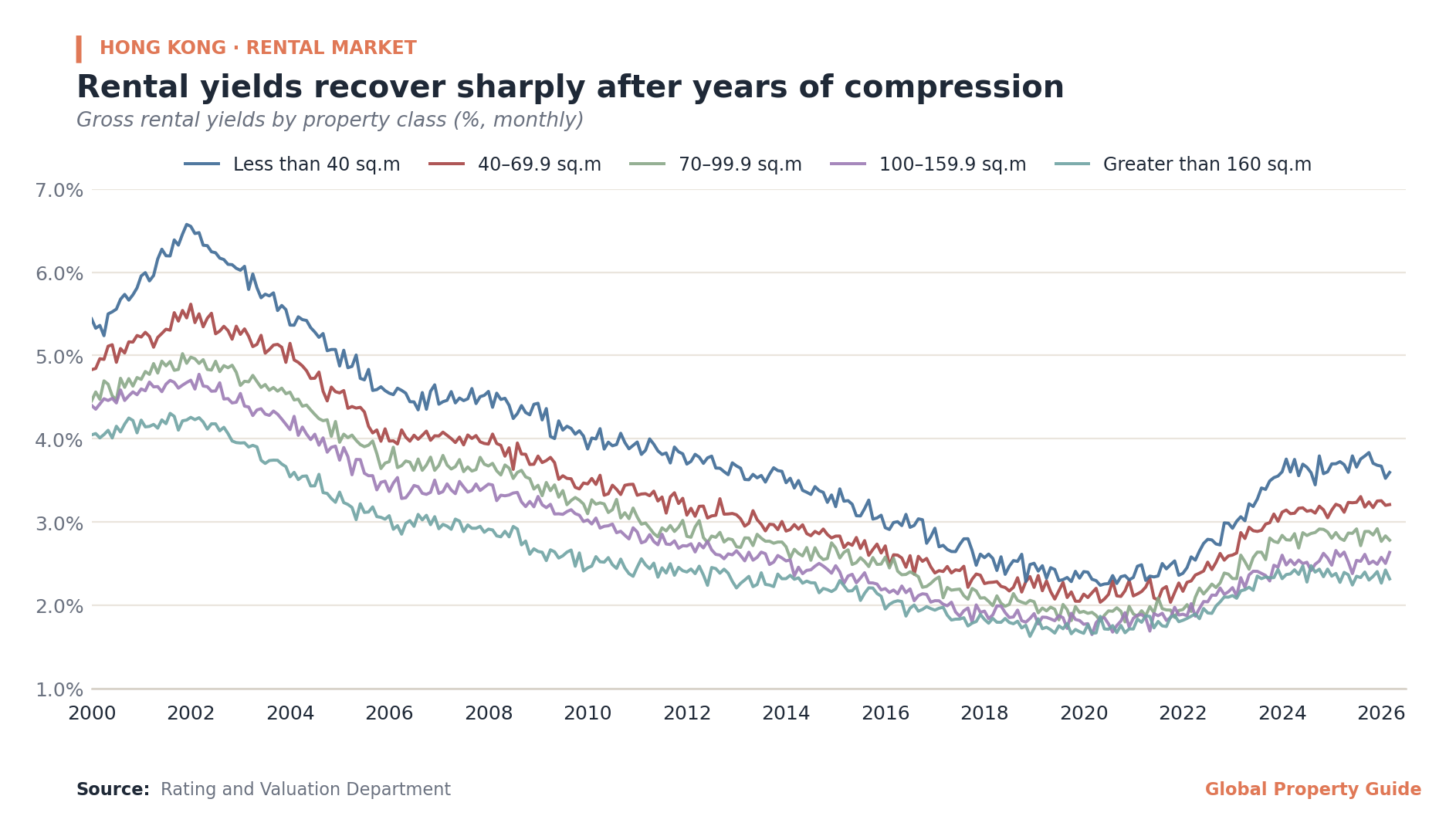
While Hong Kong's rental yields are gradually rising, they remain extremely low by international standards, which can be attributed to the surge in property prices in the past decade. Hong Kong is not a 'typical' market. It is a place where the rich choose to park assets in the form of apartments, as part of a diversified asset-safeguard strategy, like Monaco and Singapore. Such markets typically have lower rental yields than more 'normal' housing markets.
Rental yields in Hong Kong in October 2025:
- Property Class A (properties with an area of 40 sq. m. and below) rental yields were 3.7%, up from 3.6% a year ago and 3.1% two years earlier, according to figures from RVD.
- Property Class B (40 to 69.9 sq. m.) rental yields stood at 3.2%, up from 3.1% in the previous year and 2.7% two years ago.
- Property Class C (70 to 99.9 sq. m.) rental yields averaged 2.8%, unchanged from the previous year but higher than the 2.4% recorded two years ago.
- Property Class D (100 to 159.9 sq. m.) rental yields averaged 2.6%, up from 2.5% in October 2024 and from 2.3% in October 2023.
- Property Class E (160 sq. m. and above) rental yields were 2.3%, slightly down from 2.4% in the previous year but up from 2.2% two years ago.
This is supported by the recent research conducted by the Global Property Guide, which showed that the average gross rental yield in Hong Kong stood at 3.9% in Q2 2025, up from 3.88% in Q4 2024, 3.52% in Q3 2024, 3.54% in Q2 2024, and 3.39% in Q1 2024.
For the latest locality-by-locality yield breakdown across Hong Kong, please refer to the Global Property Guide's Hong Kong rental yields page, which is updated biannually.
Residential rental rates movements
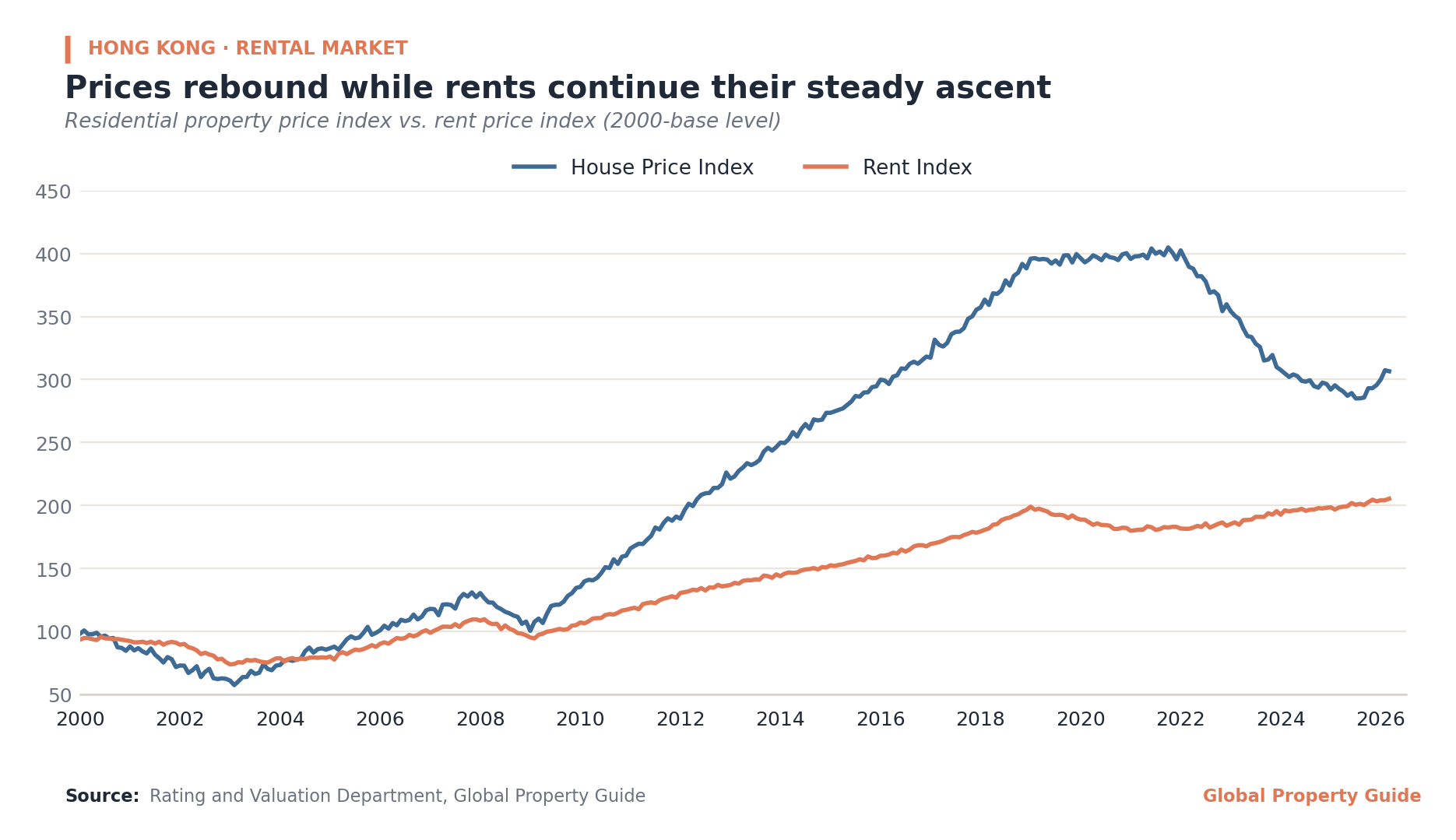
Rental rates in Hong Kong are on the rise overall, though the pace of growth differs significantly depending on the property's location and size. Rental momentum has accelerated into 2026, particularly in premium segments where supply is genuinely constrained. Property advisory firm Habitat reports that key buildings in Central Mid-Levels (including Branksome Grande, Aigburth, and Tregunter) and the South Side are fully occupied with lengthy waiting lists. Competition near international schools on the South Side is particularly fierce, with clients frequently bidding sight-unseen and above asking prices. Signature buildings such as 101, 109, and 127 Repulse Bay Road routinely attract 3-5 bidders per available unit.
"We expect South Side rentals to rise a further 15% over 2026, with Mid-Levels rentals increasing by around 10%," noted Habitat in its April 2026 market update.
Across the broader market, rent growth is moderating after the strong post-pandemic rebound. Local agencies forecast 2% to 4% growth in 2026 as the high-base effect kicks in and household incomes rise only modestly. The luxury segment is expected to continue outperforming, with JLL projecting luxury rents up to 5% higher in 2026.
Hong Kong's rent price index:
In October 2025:
- Rents for apartments smaller than 40 sqm were up by 2.5% from a year earlier, to an average of HK$ 497 (US$ 64) per sqm per month.
- Rents for 40-69.9 sqm apartments rose by 6% y-o-y, to an average of HK$ 426 (US$ 55) per sqm per month.
- Rents for 70-99.9 sqm apartments rose by 1.8% y-o-y, to an average of HK$ 449 (US$ 58) per sqm per month.
- Rents for 100-159.9 sqm apartments increased by 4.8% y-o-y, to an average of HK$ 455 (US$ 59) per sqm per month.
- Rents for apartments larger than 160 sqm were up strongly by 11% y-o-y, to reach an average of HK$ 484 (US$62) per sqm per month.
| AVERAGE RENTS, OCTOBER 2025 | ||||||
| Property size | Average rents (per sqm) | Year-on-year change | ||||
| Hong Kong | Kowloon | New Territories | Hong Kong | Kowloon | New Territories | |
| HKD (USD) | HKD (USD) | HKD (USD) | % | % | % | |
| Less than 40 sqm | 497 ($64) | 474 ($61) | 335 ($43) | 2.5 | 5.8 | 3.7 |
| 40 sqm - 69.9 sqm | 426 ($55) | 379 ($49) | 285 ($37) | 6.0 | 4.1 | 5.6 |
| 70 sqm - 99.9 sqm | 449 ($58) | 414 ($53) | 290 ($37) | 1.8 | 13.1 | 3.2 |
| 100 sqm - 159.9 sqm | 455 ($59) | 364 ($47) | 245 ($32) | 4.8 | -0.3 | 1.7 |
| Greater than 160 sqm | 484 ($62) | 424 ($55) | 221 ($28) | 11.0 | -2.8 | -10.2 |
| Sources: Ratings and Valuation Department (RVD), Global Property Guide | ||||||
Mortgage Market:
Interest rates on hold as Fed pauses
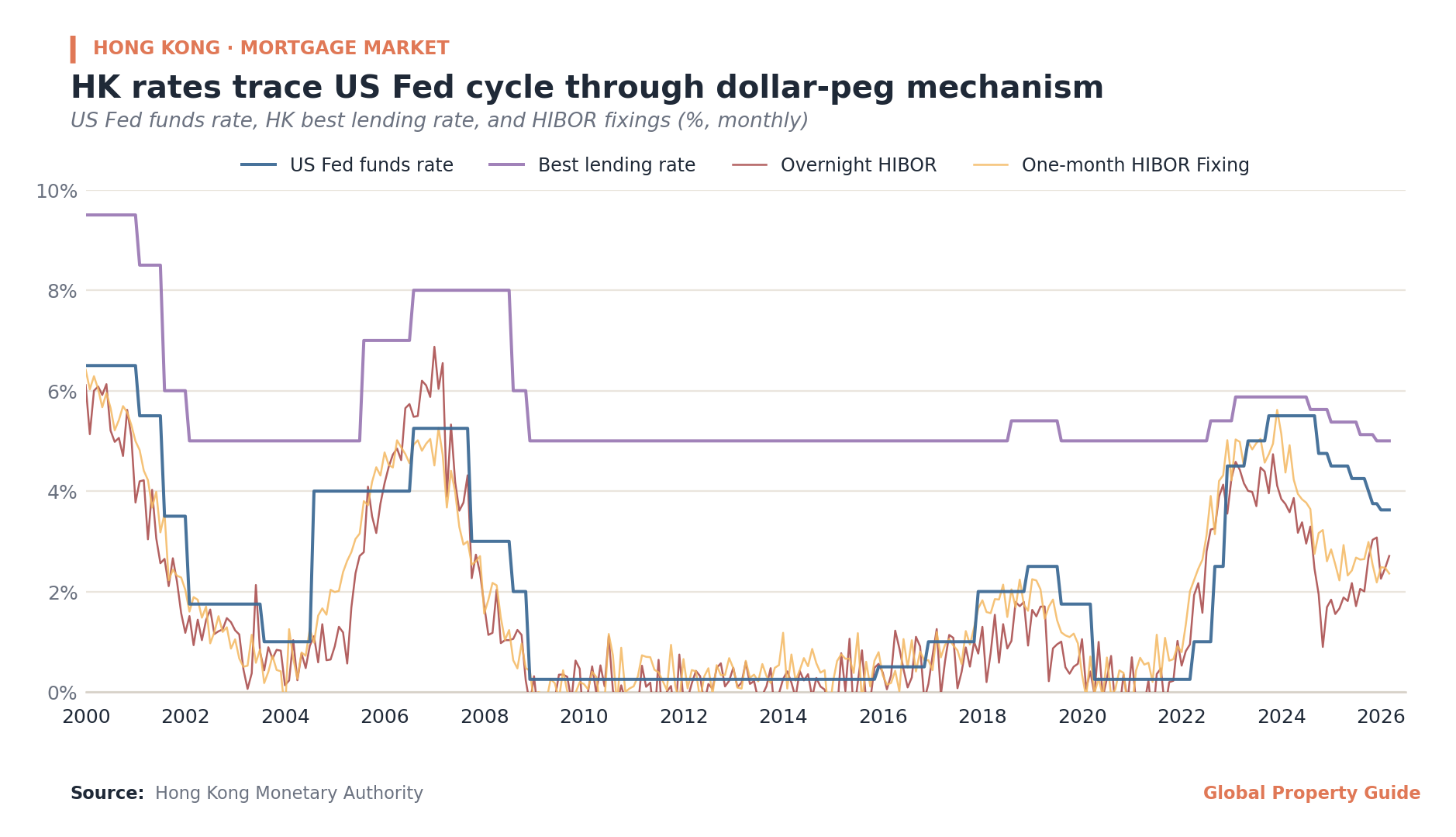
The HKMA has held its base rate steady at 4.00% through the first half of 2026, in lockstep with the U.S. Federal Reserve, which has held its target range at 3.50% to 3.75%. The HKMA most recently confirmed this position on April 30, 2026, following decisions to hold on January 29 and March 19, 2026.
"The market generally considers that the path of US monetary policy remains quite uncertain, and depends on developments in US inflation and the labour market, especially as oil prices have remained elevated amid continued tensions in the Middle East region, with the impact on US inflation still to be observed. Hong Kong's monetary and financial markets have continued to operate in an orderly manner," said the HKMA in April 2026.
The HKMA moves in lockstep with the Fed, given the local currency's peg to the US dollar.
Hong Kong's currency has been pegged at around HK$7.8 per U.S. dollar since October 1983, so when the US Federal Reserve interest rates move, so do Hong Kong's interest rates.
Prior to the current pause, the HKMA cut rates by a combined 75 basis points in 2025 (from 4.75% in August 2025 to 4.00% by December 2025), following a similar 75 basis point cut by the Fed. This brought Hong Kong's base rate to its lowest level since October 2022. Earlier, the base rate had been kept unchanged at 5.75% from July 2023 to August 2024 as inflationary pressures eased.
Major banks' best lending rates have remained largely stable in early 2026 after the cuts in 2025. HSBC Holdings PLC kept its best lending rate at 5.00% through Q1 2026. The bank's best lending rate was last changed in October 2025, when it was cut by 12.5 basis points.
Hang Seng Bank and Bank of China (Hong Kong) have also maintained their Hong Kong dollar prime lending rate at 5.00% through Q1 2026. Other major lenders, including Standard Chartered, Bank of East Asia, and Shanghai Commercial Bank, have kept their lending rate at 5.25% over the same period.
Fixed-rate mortgage scheme converted from pilot to permanent program
At the height of the Covid-19 pandemic, the Hong Kong Mortgage Corporation Limited (HKMC) introduced a pilot scheme for fixed-rate mortgages for 10, 15, and 20 years to reduce homebuyers' risks from interest rate volatility, thereby improving the banking sector's long-run stability. The maximum loan amount for residential mortgages under the scheme is HK$10 million (US$1.28 million). At the end of the fixed-rate period, the borrower has the option to re-fix the mortgage rate or convert it to a floating-rate loan.
In October 2021, HKMC announced that the scheme would be converted from a pilot program into a permanent offering starting from November 1, 2021.
"Proposed in the 2020-21 Budget, the Fixed-rate Mortgage Scheme has approved loans totaling around HK$400 million in the past year and a half. This reflects a certain market demand for fixed-rate mortgage products," said Financial Secretary Paul Chan. "The scheme has filled a market gap, and its permanent offer will continue to provide an alternative financing option to homebuyers for mitigating their risks arising from interest rate volatility, thereby enhancing banking stability in the long run."
The fixed interest rates per annum under the scheme, which was maintained until January 2022, were as follows:
| FIXED-RATE MORTGAGE PILOT SCHEME | |||
| Fixed-rate period | Gross Mortgage Rate (GMR) | Full/Partial Prepayment Penalty (% of the Prepaid Amount) | |
| Fixed interest rate | GMR after the fixed-rate period | ||
| 10-year | 1.99% | The then prevailing fixed mortgage rate or Hong Kong Prime Rate minus 2.35% | 1st year: 3% 2nd year: 2% 3rd year: 1% |
| 15-year | 2.09% | ||
| 20-year | 2.19% | ||
| Source: HKMC | |||
After that, the new rates are announced monthly. Currently, the new fixed interest rates are as follows, based on the HKMC website:
- For 10-year mortgage loans: 4.00%
- For 15-year mortgage loans: 4.15%
- For 20-year mortgage loans: 4.30%
New mortgage lending surges into 2026
New residential mortgage lending has surged sharply into 2026. In March 2026, the number of mortgage applications jumped 26.9% month-on-month to 10,311, while mortgage loans approved soared by 38.6% from February to HK$40.1 billion (US$5.16 billion), according to the HKMA's Residential Mortgage Survey for March 2026.
Within these approvals:
- Mortgage loans financing primary market transactions increased by 55.9% month-on-month to HK$13.4 billion (US$1.72 billion).
- Loans financing secondary market transactions increased by 36.1% month-on-month to HK$23.4 billion (US$3.01 billion).
- Mortgage loans for refinancing increased by 5% month-on-month to HK$3.3 billion (US$425 million).
Mortgage loans actually drawn down during March 2026 increased by 63.9% month-on-month to HK$26.9 billion (US$3.46 billion). The ratio of new mortgage loans priced with reference to HIBOR decreased from 87.5% in February to 83.7% in March 2026, suggesting some borrowers are increasingly opting for prime-linked products.
For January 2026, mortgage applications totalled 8,785 (up 15.4% month-on-month) and approved loans reached HK$32.5 billion (US$4.18 billion). February 2026 saw a temporary dip with 8,125 applications and HK$29 billion in approvals.
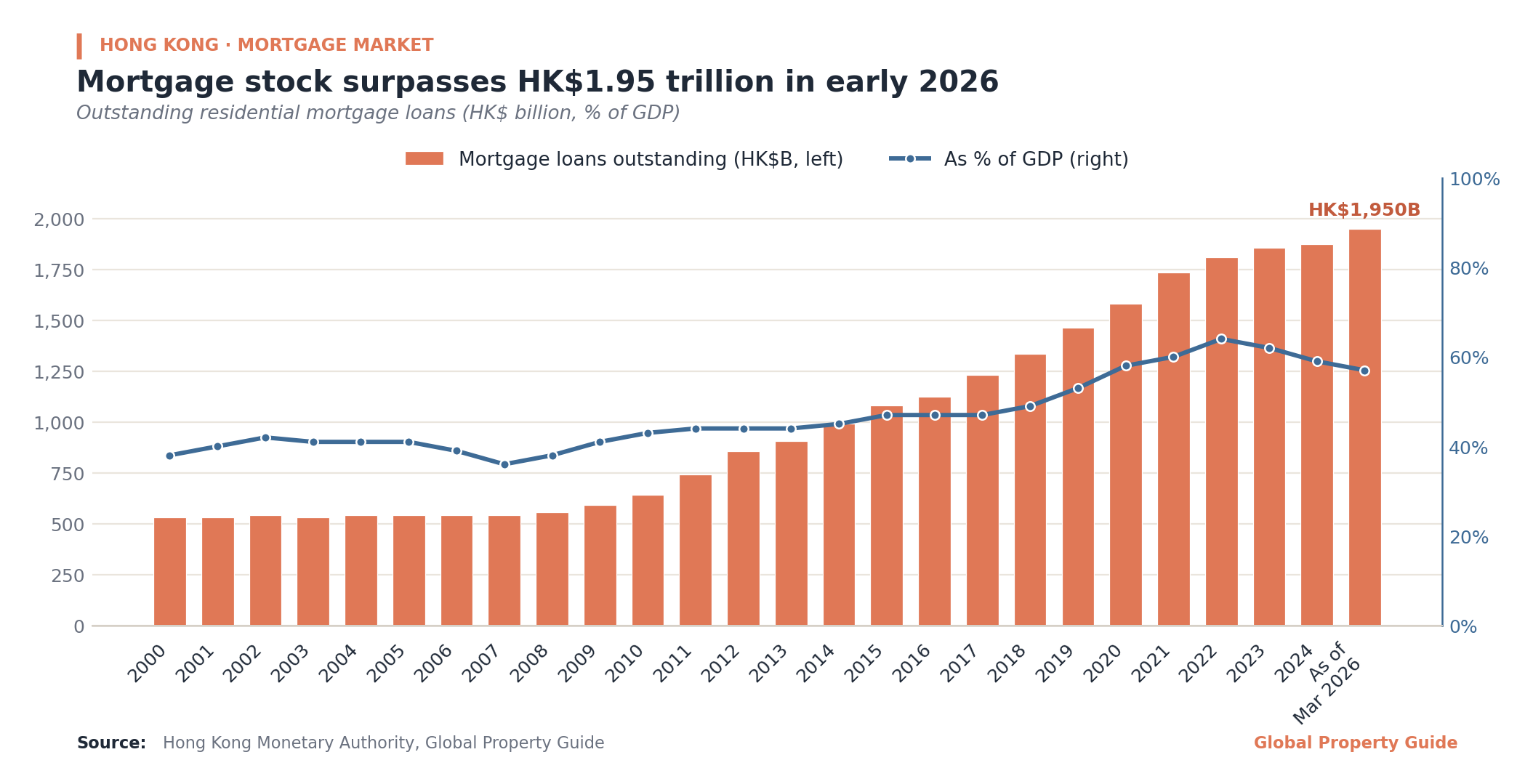
The outstanding value of mortgage loans expanded by 0.3% month-on-month to HK$1,923.4 billion (US$247.27 billion) at end-January 2026, and continued growing through Q1 to surpass HK$1.95 trillion by the end of March 2026.
Looking back at the October 2025 data, new residential mortgage loans approved had risen sharply by 52.7% to 6,305, as compared to 4,130 in the same period last year. The value of newly approved residential mortgage loans soared by 65.2% y-o-y to HK$31.34 billion (US$4.03 billion). The secondary market accounted for about 54.9% of all new mortgage loans approved during October 2025.
The mortgage delinquency ratio remained at a low level of 0.13% in early 2026, and the rescheduled loan ratio was unchanged at nearly 0%, indicating excellent credit quality in the mortgage book despite the price corrections of recent years.
Encouragingly, the number of residential mortgage loans in negative equity has fallen sharply. The estimated number of RML cases in negative equity stood at 21,304 at end-December 2025, down significantly from 31,449 cases at end-September 2025, according to the HKMA. The aggregate value of RMLs in negative equity decreased to HK$105.4 billion (US$13.55 billion) at end-December 2025 from HK$156.8 billion (US$20.16 billion) at end-September 2025.
The average loan-to-value (LTV) ratio of newly approved loans stood at 61.5% in October 2025, down from 62.2% in the previous month but higher than the 60.5% recorded a year earlier.
Though relative to GDP, the size of the mortgage market continues to shrink. This suggests that the economy is expanding at a faster pace than the mortgage sector. During 2024, the mortgage market was equivalent to about 58.9% of GDP, down from around 62.2% in 2023 and 64.4% in 2022, but still far higher than the 43.6% a decade ago.
Socio-Economic Context:
Economy posts strongest growth in nearly five years
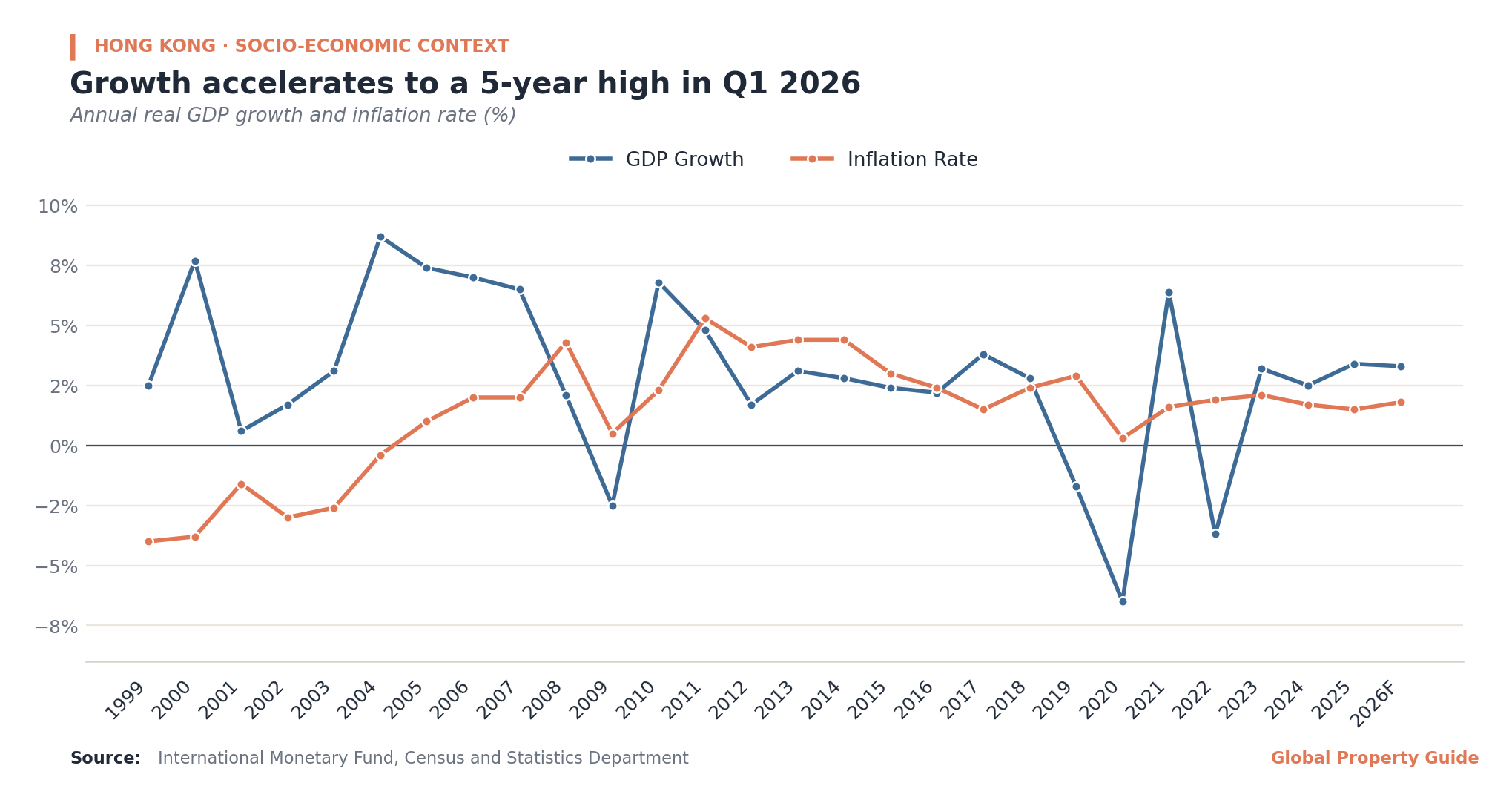
Hong Kong's service-oriented economy expanded robustly in Q1 2026, with real GDP rising 5.9% year-on-year - the strongest quarterly expansion in nearly five years (since Q2 2021). This was up from a revised 4.0% growth in Q4 2025 (originally estimated at 3.8%), according to advance estimates released by the Census and Statistics Department. On a seasonally-adjusted quarter-on-quarter basis, real GDP rose notably by 2.9% in Q1 2026.
"The Hong Kong economy expanded robustly in the first quarter of 2026," said the Hong Kong government. "Looking ahead, Hong Kong's economic growth outlook remains positive, underpinned by strong global demand for artificial intelligence (AI)-related electronics, sustained growth in visitor arrivals, and robust cross-boundary financial activities. Relatively solid business and consumer sentiment is expected to continue supporting domestic demand."
In Q1 2026:
- Private consumption expenditure increased by 5.0% in real terms over the year earlier, faster than the 2.5% increase in Q4 2025.
- Government consumption expenditure rose by 2.9%.
- Gross domestic fixed capital formation surged by 17.7% year-on-year, driven primarily by AI-related electronic equipment investment.
- Total exports of goods measured in national accounts terms recorded an increase of 23.8% in real terms.
- Merchandise exports in March 2026 alone grew by 35.8% over a year earlier on the back of strong global demand for AI-related electronic products.
- Retail sales in March 2026 increased by 12.8% over a year earlier, with growth in sales of most broad types of retail outlets.
For the full year 2025, Hong Kong's economy grew by 3.2%, supported by firm consumption, solid trade, and a continued rebound in tourism. The country registered real GDP growth rates of 3.2% in 2023, 2.5% in 2024, and 3.2% in 2025, following a contraction of 3.7% in 2022.
Major analysts have revised their 2026 growth forecasts upward. UBS maintained its Hong Kong GDP growth forecast for 2026 at 3.3%, supported by export growth in artificial intelligence and related sectors, a revival in housing transactions and higher home prices, increased fiscal revenues from stamp duty, and stabilization and gradual recovery in consumption.
"If there are unexpected shocks to the economy again, we believe the government could still use the resilient fiscal reserve to offer counter-cyclical support if necessary," UBS economist William Deng noted.
Eric Zhu, an economist at Bloomberg Economics, forecast Hong Kong's economy would expand 3.4% in 2026: "Rising optimism tied to DeepSeek-style breakthroughs lifted the stock market. A rebound in home prices from the bottom also lifted confidence. AI-related equipment drove export growth despite headwinds from higher US tariffs."
The HK economy suffered greatly for most of 2019 from social unrest as well as the US-China trade tensions, and for the whole year of 2020 from the COVID-19 pandemic. In 2020, real GDP contracted by about 6.5% from a year earlier, following a decline of 1.7% in 2019. When the first COVID-19 case was detected in January 2020, the HK government immediately rolled out social distancing measures and travel restrictions, putting further strain on the already ailing economy.
Prior to these, the HK economy had been growing by an annual average of 3.8% from 2000 to 2018.
Inflationary pressures remain manageable. In November 2025, overall inflation was 1.2%, unchanged from the previous month but still slightly down from 1.4% a year earlier, according to the Census and Statistics Department. Faster increases in food and transport prices, together with a smaller decline in clothing and footwear costs, were counterbalanced by slower price growth in miscellaneous services and a further decrease in electricity, gas, and water prices.
The HK government revised down its 2025 forecasts for underlying and headline inflation to 1.2% and 1.5%, respectively, from earlier projections of around 1.5% and 1.8%. For 2026, inflation is expected to remain modest, projected at around 1.5% to 1.8%, although elevated oil prices linked to Middle East tensions pose some upside risk.
Hong Kong's inflation rate averaged 3.3% from 2010 to 2019 before slowing sharply to 0.25% in 2020. Then inflation rose again to 1.6% in 2021, 1.9% in 2022, and 2.1% in 2023. Inflation eased to 1.7% in 2024 and moderated further to around 1.5% in 2025. In early 2026, inflation has remained subdued at approximately 1.2% to 1.5%, although elevated oil prices linked to Middle East tensions pose some upside risk through the rest of the year.
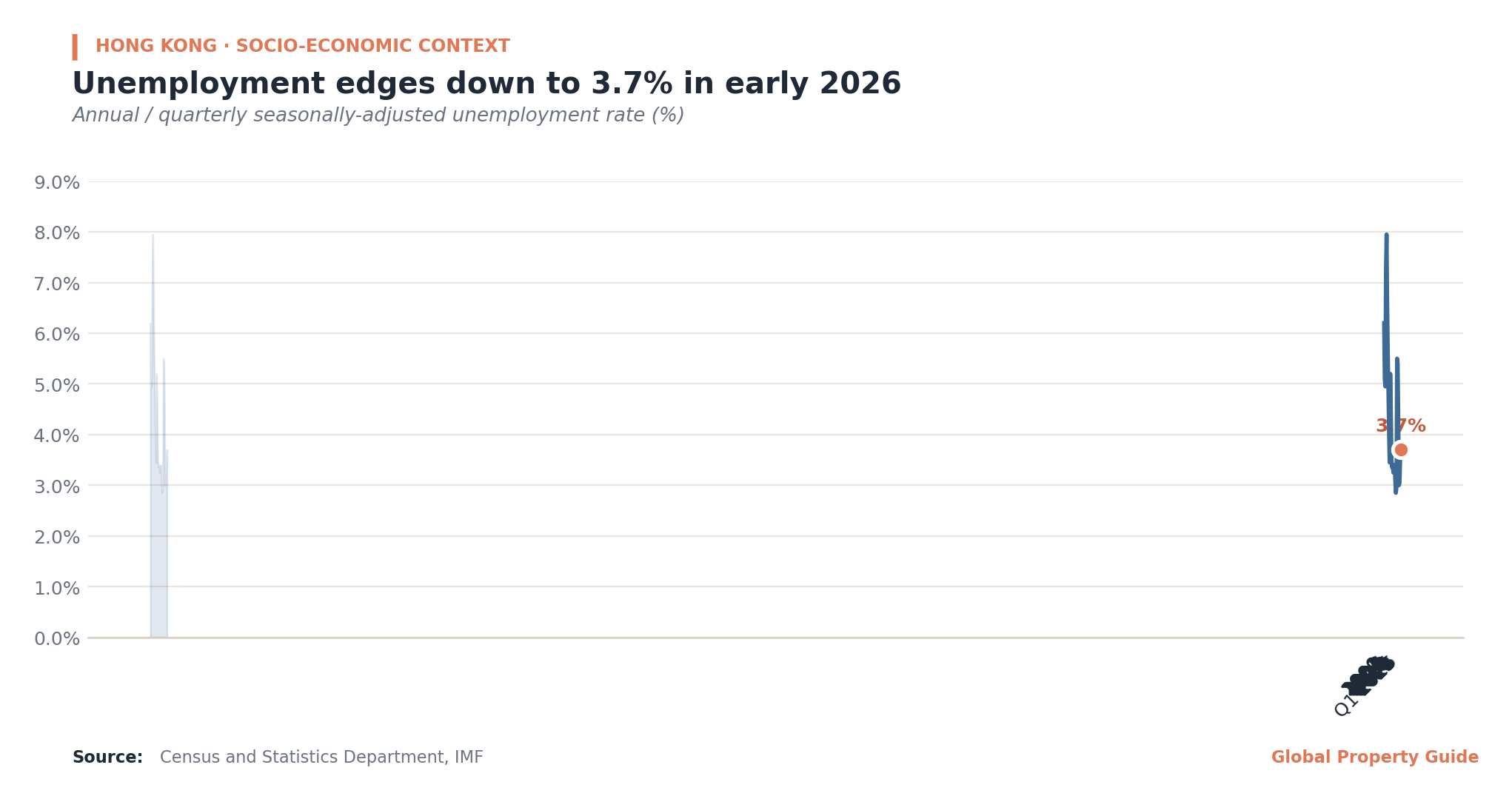
The labor market is now showing signs of stabilisation. The seasonally-adjusted unemployment rate edged down to 3.7% in January-March 2026, from 3.8% in the preceding three-month period, based on figures from the Census and Statistics Department. The underemployment rate also edged down by 0.1 percentage point to 1.6%. Over the same period, the labour force and total employment decreased slightly.
"Looking ahead, the sustained growth of the Hong Kong economy should underpin the overall labour market. The Government will continue to closely monitor the developments in geopolitical tensions and assess the potential implications for the labour market," said the government.
Tourism rebound continues with strong Q1 2026
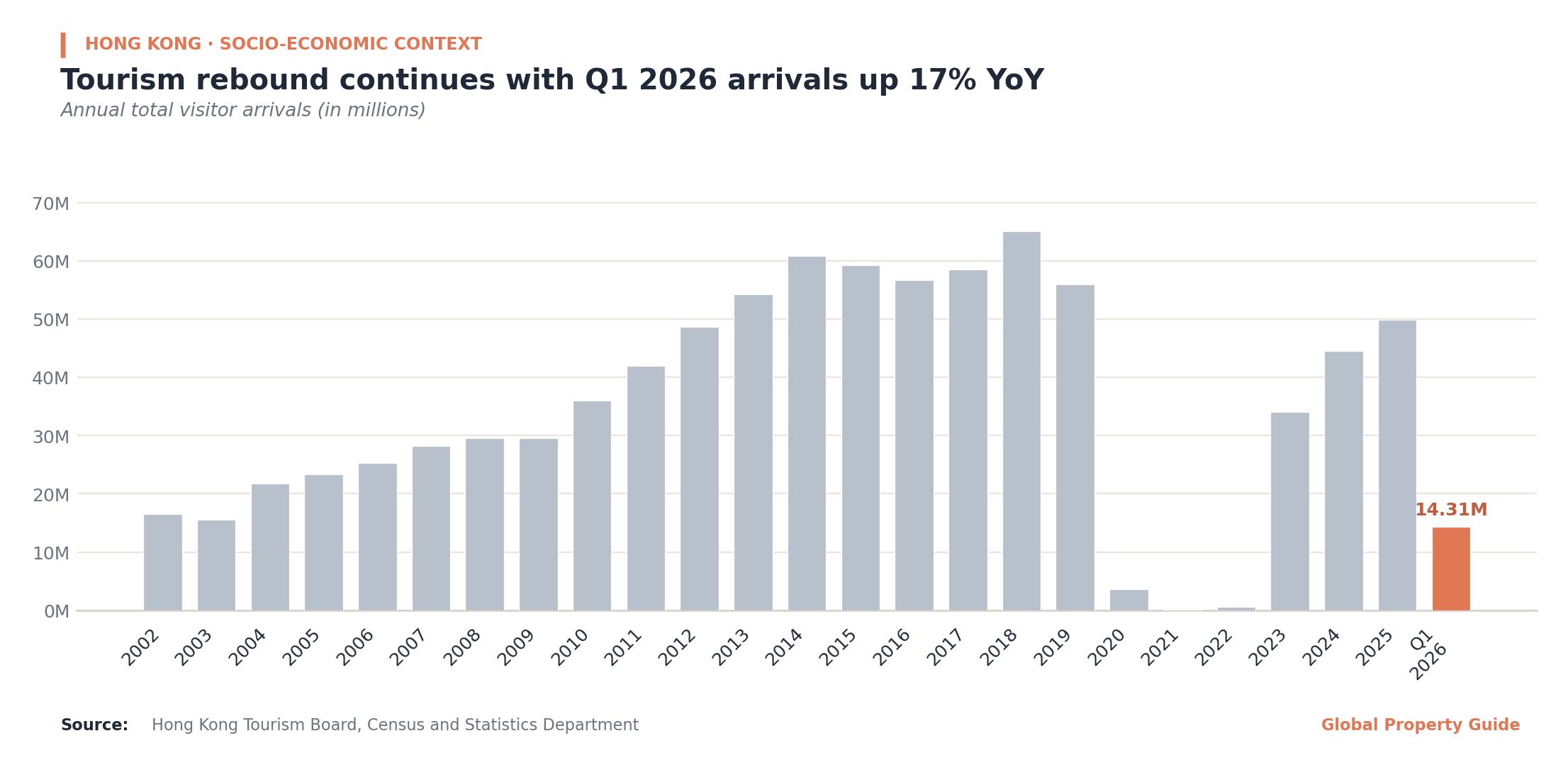
Tourism continues to recover strongly. During 2025, the total number of visitor arrivals in Hong Kong reached 49.9 million people, up by approximately 12% from 44.5 million in 2024, according to figures from the Hong Kong Tourism Board (HKTB). Markets including Taiwan, Japan, Vietnam, Australia, and the Middle East saw robust growth with year-on-year increases of 25% or more. Long-haul visitors from the US, Canada, and the UK saw a 20% rise — the most significant spike among all visitor types. The average length of stay for overnight visitors was 3.1 nights, with overnight visitors rating their satisfaction with Hong Kong at 8.9 out of 10 points.
The momentum has accelerated into 2026. For Q1 2026, total visitor arrivals reached 14.31 million, up 17% year-on-year. Visitors from Mainland China reached 11.08 million, reflecting a 20% increase, supported by major events and promotional campaigns linked to the extended Lunar New Year period. Hong Kong recorded 4.35 million visitors in March 2026 alone, a 14% increase compared with the same period last year. Officials now expect total tourist numbers for 2026 to surpass an earlier forecast of 53.8 million, lifting spending in retail, catering, hotels, and transport.
"Along with the improvement of the business environment in Hong Kong to accommodate mainland tourists, the number of mainland tourists to the city is expected to continue to rise in the upcoming years," analyst Song noted in January 2026, reflecting on the 49.9 million arrivals milestone.
Visitor growth was supported by increased air capacity, the return of international cruise liners, and a series of art and cultural events, including Art Basel Hong Kong, Art Central, and ComplexCon Hong Kong. Notable results from long-haul markets included Australia, France, and Germany, where visitor numbers grew by 20% to 30% year-on-year in the first two months of 2026.
Despite the recent surge, 2025's 49.9 million arrivals remained about 23% lower compared to the record-high 65.1 million arrivals registered in 2018, suggesting further upside potential.
Tourist arrivals averaged about 56 million people annually from 2011 to 2019. However, tourism became almost nonexistent in the following three years due to pandemic-related travel restrictions. Arrivals dropped to 3.57 million people in 2020, and then to just 91,398 people in 2021 and 604,564 people in 2022. In 2023, the tourism sector showed considerable improvements, registering visitor arrivals of 34 million people, growing further to 44.5 million in 2024 and 49.9 million in 2025.
Sources:
- Property Market Statistics (Rating and Valuation Department): https://www.rvd.gov.hk/
- Hong Kong Home Prices & Rents Hit New Highs in February 2026 (IndexBox): https://www.indexbox.io/
- Hong Kong Property Market Update April 2026 (Habitat Property): https://www.habitat-property.com/
- Demographia International Housing Affordability 2025 Edition (Chapman University): https://www.chapman.edu/
- Cost of Living City Ranking 2024 (Mercer): https://www.mercer.com/
- UBS Global Real Estate Bubble Index 2025 (UBS): https://www.ubs.com/
- Countercyclical macroprudential measures for property mortgage loans (Info.gov.hk): https://www.info.gov.hk/
- New measures with effect from 17 September 2025 (New Capital Investment Entrant Scheme Office): https://www.newcies.gov.hk/
- LegCo passes stamp duty bill to ease burden on HK low-end home buyers (China Daily): https://www.chinadailyhk.com/
- Government welcomes passage of Stamp Duty (Amendment) Bill 2025 (Government of HKSAR): https://www.info.gov.hk/
- Hong Kong Budget 2024: Extra stamp duties axed in bid to revive housing market (Hong Kong Free Press): https://hongkongfp.com/
- Hong Kong Q1 GDP surges 5.9% in real terms, hitting near 5-year high (Xinhua/China.org): http://www.china.org.cn/
- HK economy posts strongest growth in almost five years (China Daily Asia): https://www.chinadailyasia.com/
- Hong Kong Economy - Latest Developments (HK Government): https://www.hkeconomy.gov.hk/
- Hong Kong Visitor Arrivals - Q1 2026 (TTG Asia / HKTB): https://www.ttgasia.com/
- HKTB Announces 49.9 Million Visitors Received in Hong Kong in 2025 (Hong Kong Tourism Board): https://www.discoverhongkong.com/
- Hong Kong Q1 2026 GDP: Xinhua (Xinhua): https://english.news.cn/
- HKMA's Response to US Fed's Interest Rate Decision (April 2026) (Hong Kong Monetary Authority): https://www.hkma.gov.hk/
- Residential Mortgage Survey Results for March 2026 (Hong Kong Monetary Authority): https://www.hkma.gov.hk/
- Residential Mortgage Survey Results for January 2026 (Hong Kong Monetary Authority): https://www.hkma.gov.hk/
- HSBC maintains its best lending rate at 5.00 per cent in Hong Kong (HSBC): https://www.about.hsbc.com.hk/
- Permanent Offer of Fixed-rate Mortgage Scheme (Hong Kong Monetary Authority): https://www.hkma.gov.hk/
- Fixed Rate Mortgage Scheme (Hong Kong Mortgage Corporation): https://www.hkmc.com.hk/
- Gross rental yields in Hong Kong (Global Property Guide): https://www.globalpropertyguide.com/
- Hong Kong House Price Index (Global Property Guide): https://www.globalpropertyguide.com/
- Hong Kong Rent Price Trends (Global Property Guide): https://www.globalpropertyguide.com/
- Hong Kong House price index, December 2025 (BIS / TheGlobalEconomy): https://www.theglobaleconomy.com/
- Hong Kong in Figures 2025 (Census and Statistics Department): https://www.censtatd.gov.hk/
- Government releases Long Term Housing Strategy Annual Progress Report 2025 (Government of HKSAR): https://www.info.gov.hk/
- Tourism Statistics (Hong Kong Tourism Board): https://www.discoverhongkong.com/
- Visitor arrivals to Hong Kong up 18% in early 2026 (China Daily): https://www.chinadaily.com.cn/
- Consumer Price Indices (Census and Statistics Department): https://www.censtatd.gov.hk/