Egypt Residential Property Market Analysis 2026
Egypt’s housing market remains on a steady upward path, fueled by strong demand and underpinned by major economic reforms, including repeated currency devaluations and the recent liberalization of foreign land ownership.
Drawing on Global Property Guide analysis, this extended overview explores the main characteristics of Egypt’s housing market, with particular emphasis on recent developments and longer-term trends.
Table of Contents
- Property Prices and Price Index
- Historic Perspective
- House Price Variations
- Property Demand Trends
- Property Supply Trends
- Rental Market: Rents and Rental Yields
- Mortgage Market and Interest Rates
- Economic and Social Factors
Property Prices and Price Index
In October 2025, the nationwide real estate price index rose by 13.25% from a year earlier, lower than the year-on-year price growth of 25.8% recorded in the same period last year, based on figures from Egypt’s leading real estate portal, Aqarmap. When adjusted for inflation, real estate prices rose slightly by 0.67% over the same period.
Real estate prices in Egypt have surged by double digits from October 2022 to October 2025, with the sole exception of January 2025, when growth eased to roughly 5%. Yet in the three months to October 2025, real estate prices declined by 2.52% (-4.84% inflation-adjusted).
Prior to this, real estate prices in Egypt were up by 18.2% during 2024 (but down by 4.8% in real terms), following annual growth of 41.9% in 2023, 25.4% in 2022, and 3.6% in 2021 and a y-o-y decline of 9.6% in 2020.
Egypt's house price annual change:
Despite ongoing challenges, the outlook for Egypt’s housing market remains positive, bolstered by resilient demand and strengthened by government initiatives and an improving economic environment.
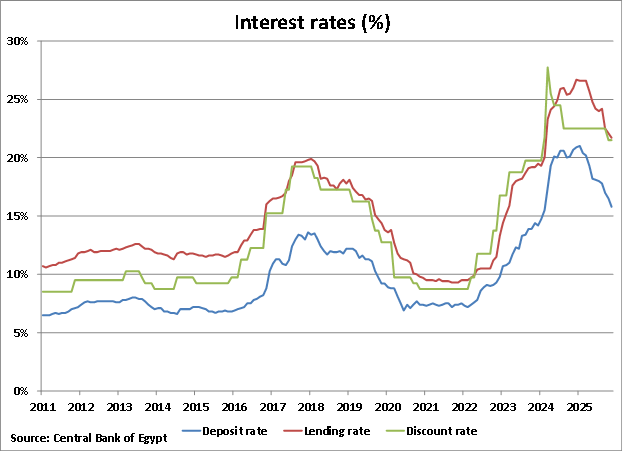
“Looking ahead, Cairo’s freehold residential market is expected to experience a notable pickup as declining interest rates encourage investors to shift from bank deposits to real estate assets. The cumulative 525 basis point reduction throughout 2025 (from 27.25% to 22%) reflects improving economic fundamentals and should revitalise both primary and secondary markets,” said JLL MENA in its Q3 2025 Cairo Living Market Dynamics report. “Further rate cuts are anticipated to enhance market cashflow, facilitate land acquisitions, and spur new project launches, positioning the residential sector for renewed growth momentum.”
President Abdel Fattah el-Sisi recently removed the last restrictions on foreign ownership of land and property in Egypt, in an effort to buoy the housing market. He also allowed the government, the biggest landowner in Egypt, to use its land for public-private partnership schemes. These improvements, together with the fundamentally strong local demand, are now beginning to boost the housing market and the overall economy in general.
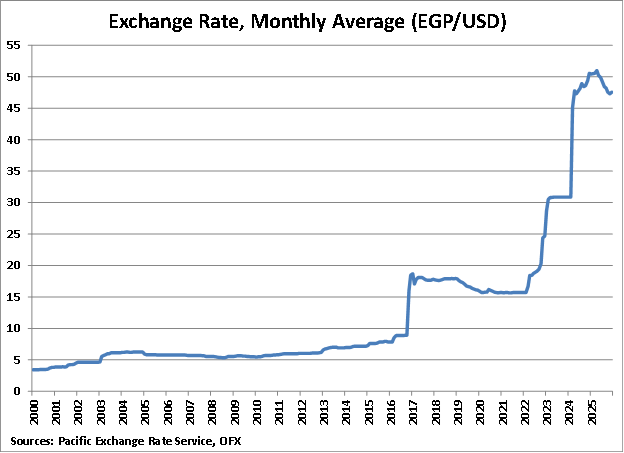
In November 2016, Egypt floated the Egyptian pound (EGP), causing a dramatic depreciation against major currencies, making real estate more attractive from the perspective of the wealthy Egyptians. If he lives abroad, Egyptian property is much less expensive because of the currency depreciation. In fact, in 2022, Egypt devalued its domestic currency twice, with a pledge to adopt a flexible exchange-rate policy, eventually helping the country clinch a US$3 billion loan from the International Monetary Fund (IMF).
In January 2023, the central bank devalued the domestic currency for the third time, resulting in a loss of approximately 40% of its value. Then, in early March 2024, the country devalued its domestic currency again by more than 38% to pave the way for billions more in loans from the IMF. As a result, the average exchange rate reached EGP 50.56 per USD 1 in December 2024, a more than 82% cumulative decline from its value of EGP 8.88 per USD 1 before the decision to float the currency in 2016. As of December 2025, the exchange rate stabilized at an average of EGP 47.54 per USD 1.
There is a huge, real demand for housing in Egypt, as the country’s population increases by 2.5 million annually, and there are about one million marriages taking place every year.
There is also increasing foreign demand in the country. Foreigners can buy property in Egypt under Law No. 230 of 1996. However, foreigners cannot buy more than two pieces of real estate, which cannot exceed 4,000 square meters (sq. m.), and their purpose must be for a family member to live in the property. If registered, the property cannot be sold or rented for five years.
In addition, the government implemented other reforms recently:
- A value-added tax (VAT) was introduced.
- Egypt’s Investment Law was amended to attract more foreign investors.
- Fuel and electricity subsidies have been continuously reduced since 2014, as part of the government’s goal of reducing spending.
- The price of sugar was raised by 40%.
- The CBE has abolished a 'priority list' for imports.
- The time and day limits during which banks are allowed to execute foreign currency exchanges have been extended.
Other initiatives included the launch of several mega-projects to boost economic growth, including the expansion of the Suez Canal and the construction of a new capital city.
“The implementation of structural reforms, supported by the IMF program, and the shift to a durably flexible exchange rate regime are expected to relieve the pressure on external financing and accelerate reforms,” said the European Bank for Reconstruction and Development (EBRD).
Egypt has successfully weathered the adverse impact of the Covid-19 pandemic, with its real GDP rising by 3.5% in 2020 and by another 3.3% in 2021. In fact, Egypt was the only nation in the MENA that avoided negative GDP growth during the onset of the pandemic. The economy expanded by a healthy 4.3%, on average, in the past decade, as various economic reforms have successfully buoyed business investment and private consumption in the country.
After growing by 6.7% in 2022, Egypt’s economic growth moderated to 3.8% in 2023. Then in 2024, economic growth slowed further to 2.4%, due to disruptions from the Gaza conflict, a sharp drop in Suez Canal revenues, declining oil and gas output, and high inflation caused by currency depreciation and subsidy cuts. Austerity measures tied to IMF reforms also contributed to the slowdown.
But conditions have since improved as the government accelerated economic reforms. During the FY 2024/25, Egypt recorded an economic growth rate of 4.4%, according to Rania Al-Mashat, Minister of Planning, Economic Development, and International Cooperation. Then in the first quarter of FY 2025/26, Egypt’s economy expanded by 5.3%, marking the fastest growth in over three years and significantly higher than the 3.5% recorded a year earlier.
Planning Minister Rania Al-Mashat said Egypt is targeting economic growth of around 5% for the fiscal year ending June 2026, up from a previous target of 4.5%. This outlook aligns with the IMF, which has recently revised its growth forecast for Egypt upward to 5.4% in FY 2026/27, citing improving economic indicators.
Historic Perspective:
Egypt’s housing market cycle
Egypt has seen erratic house price movements in recent years, buffeted by economic and political events.
Property prices in Egypt rose by 13.7% (4.5% in real terms) in 2005 but fell by 0.4% (-4.4% in real terms) in 2006 and by another 0.6% (-10.4% in real terms) in 2007, according to the 2008 Egypt Housing Survey conducted by Bearing Point Inc, which had a cross-Egypt sample. House prices fell further in 2008, due to the global financial crisis. In fact, by the end of 2009, house prices in the secondary market had fallen by about 37%, in real terms, according to local real estate analysts.
Egypt’s housing market recovered strongly in early 2010, mainly due to robust economic growth, rising by about 10% in 2010. For a long time, the housing market was stable in real terms, with the nationwide real estate price index rising by 9% (-3.5% in real terms) in 2013 and by another 11.4% (2.6% in real terms) in 2014, according to the Aqarmap Real Estate Index.
The housing market weakened again in 2015, with house prices falling by 4.7% (-14.2% in real terms), amidst political uncertainty and civil unrest. But the property market bounced back immediately, with house prices rising by 24.7% (1.2% in real terms) in 2016.
In 2017, house prices rose by 7.9% in nominal terms, but actually fell by 11.5% when adjusted for inflation. The wide difference between the nominal and real figures was mainly due to extraordinarily high inflation during the period, after the government floated the Egyptian pound (EGP) in November 2016, causing a dramatic depreciation against major currencies. Other economic reforms, such as the reduction of fuel subsidies, have also broadly impacted households’ purchasing power in recent years, causing a temporary fall in real estate demand.
These have been compounded by the Covid-19 pandemic, with house prices falling by almost 10% during 2020 (-14.4% in real terms). With things slowly going back to normal, the Egyptian housing market is now showing huge improvements. House prices rose by a modest 3.6% (-2.2% in real terms) in 2021 before accelerating in 2022 by 25.4% (3.4% in real terms). In 2023, house prices surged by 41.9% (6.1% in real terms) from a year earlier.
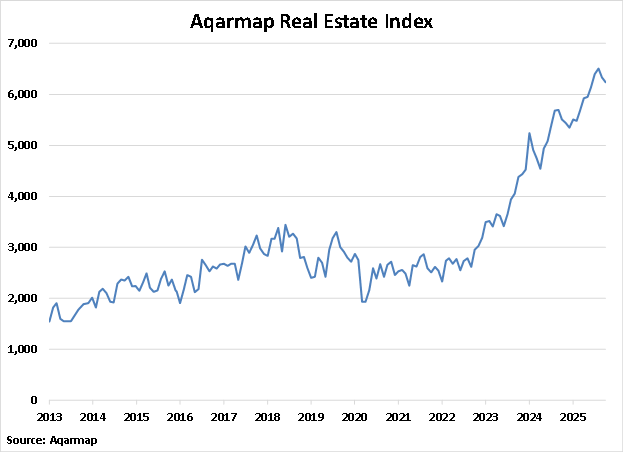
During 2024, nationwide house prices rose by 18.2% but actually declined by 4.8% when adjusted for inflation. Nominal house prices continued to increase by double-digit figures last year.
House Price Variations:
House price disparities across local markets
Properties closer to central Cairo typically command higher prices per square meter. However, residential property prices in upscale gated communities and the New Administrative Capital are quickly closing the gap.
Leading the list of Egypt’s priciest property locations are the New Administrative Capital, Dokki, El Sheikh Zayed, Zamalek, New Heliopolis, and New Cairo’s Fifth Settlement areas, favored for their modern infrastructure, amenities, and premium lifestyle offerings.
In New Cairo, where the affluent district of Fifth Settlement is located, the average price of apartments skyrocketed by 157.3% y-o-y to EGP 61,550 (US$1,320) per sqm in December 2025 while villa prices surged by 287.8% to an average of EGP 97,000 (US$2,081) per sqm over the same period, based on figures from Aqarmap.
On the 6th of October, in one of the largest industrial zones in Egypt, apartment prices rose strongly by 153.7% y-o-y to an average of EGP 47,000 (US$1,008) per sqm in December 2025, while villa prices were up by a spectacular 214.4% to EGP 74,550 (US$1,599) per sqm.
In Nasr City, Cairo’s biggest neighborhood, the average apartment price rose by 32.7% to EGP 24,450 (US$525) per sqm in December 2025 from a year earlier, while the average villa price was also up by a huge 189.3% to EGP 45,200 (US$970) per sqm.
In El Maadi, a posh suburban district south of Cairo, the average apartment price increased by 39.4% y-o-y to EGP 26,950 (US$578) per sqm in December 2025, while villa prices were up strongly by 93.1% y-o-y to EGP 43,700 (US$937) per sqm.
In El Sheikh Zayed City, an upscale integrated city known for its quietness, green areas, and moderate temperatures, apartment prices increased strongly by 185.3% y-o-y to an average of EGP 64,050 (US$1,374) per sqm in December 2025, and villa prices rose by a huge 157% to EGP 72,300 (US$1,551) per sqm.
In El Zamalek, an affluent district of western Cairo surrounding the northern portion of Gezira Island in the Nile River, the average apartment price stood at EGP 64,400 (US$1,382) per sqm in December 2025, more than three times that of the same period in the preceding year, according to Aqarmap.
| AVERAGE RESIDENTIAL PROPERTY PRICES IN GREATER CAIRO (SQM), DECEMBER 2025 | ||||
| Major areas | Apartments | Villas | ||
| EGP | USD | EGP | USD | |
| New Cairo – Fifth Settlement | 61,550 | 1,320 | 97,000 | 2,081 |
| 6thof October | 47,000 | 1,008 | 74,550 | 1,599 |
| El Sheikh Zayed | 64,050 | 1,374 | 72,300 | 1,551 |
| Heliopolis –MsrElGedida | 47,450 | 1,018 | - | - |
| Nasr City | 24,450 | 525 | 45,200 | 970 |
| ElMaadi | 26,950 | 578 | 43,700 | 937 |
| ElOubour | 21,900 | 470 | 50,100 | 1,075 |
| Faisal | 9,800 | 210 | 27,250 | 585 |
| El Zamalek | 64,400 | 1,382 | - | - |
| ElMohandessen | 28,800 | 618 | 45,550 | 977 |
| Dokki | 34,400 | 738 | 89,700 | 1,924 |
| El Haram | 10,150 | 218 | 31,700 | 680 |
| Giza | 9,800 | 210 | 50,250 | 1,078 |
| Mokattam | 18,800 | 403 | - | - |
| Helwan | 10,450 | 224 | 33,050 | 709 |
| Ain Shams | 10,600 | 227 | 29,100 | 624 |
| Badr City | 9,950 | 213 | 20,050 | 430 |
| Garden City | 31,450 | 675 | - | - |
| Downtown -West El Bald | 17,350 | 372 | - | - |
| El Zaytun | 14,750 | 316 | 47,750 | 1,024 |
| HadayekEl Koba | 15,500 | 333 | - | - |
| HadayekElAhram | 15,350 | 329 | 17,750 | 381 |
| Shoubra | 16,650 | 357 | - | - |
| Imbaba | 12,900 | 277 | - | - |
| ElAgouza | 21,500 | 461 | 63,100 | 1,354 |
| Manial | 33,350 | 715 | 54,400 | 1,167 |
| ElAbbasiya | 19,050 | 409 | - | - |
| 15th of May | 11,300 | 242 | 34,700 | 744 |
| ElNozha | 19,300 | 414 | - | - |
| El Sayyeda Zeinab | 13,150 | 282 | - | - |
| El Khalifah | 10,200 | 219 | - | - |
| ElOmraneya | 9,350 | 201 | - | - |
| ElMataria | 8,300 | 178 | - | - |
| El Marg | 4,100 | 88 | - | - |
| Madinat El Salam | 6,600 | 142 | - | - |
| ElSharabeya | 7,250 | 156 | - | - |
| ElBasateen | 5,900 | 127 | - | - |
| Bashtil | 6,250 | 134 | - | - |
| New Heliopolis | 60,650 | 1,301 | - | - |
| New Administrative Capital | 51,400 | 1,103 | 87,200 | - |
| ElShoroukCity | 31,800 | 682 | 73,750 | - |
| Data Sources: Aqarmap, Global Property Guide | ||||
There are also numerous investment locations outside Greater Cairo.
On the North Coast, which covers the northern territory of Egypt along the Mediterranean Sea, the average price of apartments was EGP 76,150 (US$1,634) per sqm in December 2025, up by a whopping 209% from a year earlier.
Alexandria, one of Egypt’s largest cities, a principal seaport, and a major industrial hub, offers a wide range of residential properties. Currently, the average apartment price is EGP 7,950 (US$171) per sqm, up by 5% from a year ago. On the other hand, villas have an average price of EGP 29,700 (US$637) per sqm, an increase of 68% from the prior year. Alexandria is best known for the Lighthouse of Alexandria (Pharos), one of the Seven Wonders of the Ancient World.
In Ain El Sokhna, a seaside city lying on the western shore of the Red Sea’s Gulf of Suez, the average apartment price skyrocketed by 283% y-o-y to EGP 91,200 (US$1,956) per sqm in December 2025.
Property Demand Trends
The ambitious ‘New Administrative Capital’
The Cairo metropolitan area is now nearing 20 million people, making it one of the most congested cities in the world. In fact, traffic costs amounted to about 4% of Egypt’s entire GDP, according to World Bank estimates.
To address these problems, the Egyptian government has been building a new administrative and financial capital since 2015. Originally dubbed “Cairo Capital” and “global city for Egypt’s future”, the New Administrative Capital will address crowding, pollution, and rising house prices in Cairo. The city will be developed in phases over 40 years, according to the then-housing minister, Mostapha Madbouly.
The new capital, which is located about 40 km east of Cairo, is being built on 69,000 hectares, about two times the size of Cairo.
The new capital could house up to 7 million people, with the initial plans including 21 residential districts housing 1.1 million residential units, 40,000 hotel rooms, 663 healthcare facilities, 1.8 million sq. m. of residential space, and 1,250 mosques and churches. The plan also includes a new presidential palace, a new parliament building, new buildings for various government administrations, and an area dedicated to foreign embassies.
Phase 1 has an estimated cost of about US$45 billion.
Plans for Phase II were initially slated to begin in 2024, but the planned expansion of an additional 40,000 feddans has been postponed to 2026.
Over 30 skyscrapers are currently under construction, including the Iconic Tower, which is poised to become the tallest skyscraper in both Egypt and Africa.
Misr Stadium, the largest in the region, is now operational, with the stadium having opened in early 2024.
The new capital city is envisioned as a “Smart City” which will “take advantage of the sustainable technologies of today as well as be adaptable to future technologies,” according to Cairo Capital’s website.
Since 2023, various ministries and government entities have been relocated to the new capital city.
On April 2, 2024, President Abdel Fattah al-Sisi was sworn in for a third consecutive term, marking the official inauguration of the New Administrative Capital as Egypt’s new seat of government.
Currently, however, residential property prices in the New Administrative Capital have risen to levels that are out of reach for mid-level employees with an annual average income of just US$4,800. As such, most employees opted to commute from Cairo using the Light Rail Transit system or other nearby cities.
Property Supply Trends
Residential construction activity increasing
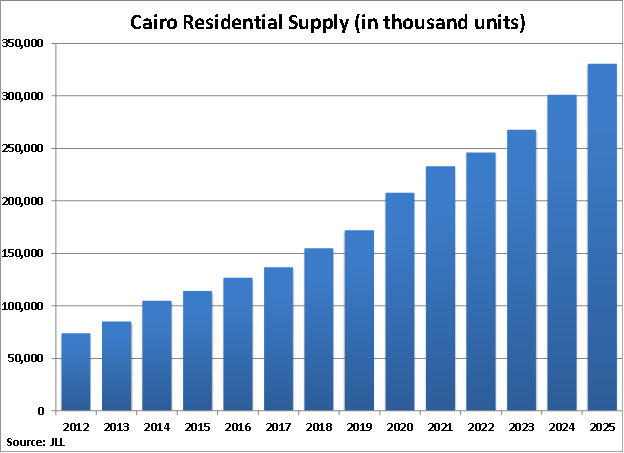
In the third quarter of 2025, about 7,500 new residential units were completed in Cairo, particularly in the New Administrative Capital’s R7 district, according to JLL, amidst continued strong demand despite high residential prices. This followed full-year residential completions of 24,000 units in 2024, 23,000 units in 2023, and 18,000 units in 2022. This brought the total stock in Cairo to approximately 317,000 units by the end of Q3 2025.
“In Q3 2025, approximately 7,500 new residential units were delivered, predominantly apartments in the R7 district of the New Administrative Capital (NAC), as more developers began the phased handover process to buyers. Nevertheless, the R7 district remains an active construction zone with continuous development activity, making it unlikely that these new owners will be able to occupy these units immediately,” said JLL’s Cairo Living Market Dynamics Q3 2025 report. “This completion has expanded the total residential stock to over 317,000 units, while a further 13,800 units are projected to be delivered by the end of Q4 2025.”
Egypt’s residential construction sector has remained comparatively resilient in the face of global economic and geopolitical pressures. While rising uncertainty has weighed on activity, sustained public sector investment and increasing foreign participation continue to underpin market momentum and create new opportunities for developers. Looking ahead, the sector’s performance will depend on the ability of stakeholders to leverage strategic partnerships, adopt innovative delivery models, and mitigate risks stemming from higher input costs and ongoing supply-chain constraints.
However, investments in the lower segments of the market remain weak. The country’s major developers tend to cater exclusively to the upper middle and upper classes due to the absence of efficient mortgage law.
Approximately 50% of the population is classified as lower income, and around 37% of urban space in Egypt consists of informal settlements, while “unsafe slums” are roughly 1% of urban areas, according to Sherif El-Gohary of the Ministry of Urban Renewal and Informal Settlements.
Housing affordability still a major concern for the poor
With a population of about 109.5 million in 2025, Egypt needs around 175,000 to 200,000 additional housing units each year and has a housing shortage of about 3 million. While there are approximately 5.6 million vacant units nationwide, most of these are beyond the means of the low and middle-income classes.
In response, President El-Sisi spearheaded the construction of one million housing units for low-income youth. The US$40 billion project was a collaboration with Arabtec Holding, a UAE company. Called “For the Youth”, the project planned to house low-income people in 13 cities across the country. However, after the project broke down, Egypt pursued its own housing program with local banks and the World Bank, providing homes to 241,517 families. The government also launched the Long Live Egypt Fund, a charitable fund to serve the poor and young Egyptians in housing and health. However, they are still inadequate to solve the country's housing shortage and affordability problem.
About 44.4% of Egypt’s housing stock is occupied by owners, while about 35.7% of the housing stock is rented. Other tenure types are gifts, in-kind privileges (14.1%), and public housing (5.5%).
Low-income housing, usually priced around US$14,000 per unit, remains unaffordable, and most developers do not supply houses to this income group.
The price of the cheapest social housing units has risen, on average, by about 15% to 20% annually over the past decade, while average incomes only increased by 1% per year over the same period.
Rental Market: Rents and Rental Yields
Rental market continues to grow rapidly, with surging rents
Rents for high-end residential properties in Cairo, which are sometimes paid in US dollars, continue to rise rapidly, supported by strong demand.
In the 6th of October district, apartment rentals soared by a huge 17.6% in Q3 2025 as compared to the same period last year, following annual growth of more than 100% in 2024, 25% in 2023, 9% in 2022, 2% in 2021, and 8% in 2020, according to JLL MENA’s Cairo Living Market Dynamics Q3 2025.
In New Cairo, rentals for apartments also increased by 16.9% in Q3 2025 from a year earlier, after increases of 108% in 2024, 30% in 2023, 3% in 2022, 1% in 2021, and 5% in 2020.
“An emerging trend reveals prospective home buyers opting to rent in upscale neighbourhoods, in order to elevate their living standards, where such areas are often beyond their purchasing power,” said JLL in an earlier report.
“This shift is incentivising property owners to lease rather than dispose of their residential units. Consequently, the rental market has gained appeal for both tenants pursuing better living standards and landlords aiming to maximise returns on their real estate investments,” added the JLL report.
Expats looking for apartments prefer direct methods rather than using realtors. One of the most popular methods is going to the American University in Cairo to look for apartment ads. Another one is going directly to the residential building of choice and asking the bawab or doorman for vacancies.
Good rental yields
The average gross rental yield in Egypt stood at 6.72% in Q4 2025, slightly down from 6.77% in Q2 2025 but far higher than the 5.52% recorded in Q1 2024, based on a recent survey conducted by the Global Property Guide.
In major areas:
- In Cairo, the gross rental yield is currently far higher than the national average, at 8.3% in Q4 2025. Though there are wide variations within the capital city. The average rental yield of two-bedroom apartments in New Cairo is at 7.75%; in the 6th of October, at 6.07%; in Mohandessin, at 12.47%; in Sheikh Zayed, at 6.87%; and in Heliopolis-Masr El Gedida, at 5.32%.
- In Alexandria, apartments offer gross rental yields ranging from 3.96% to 6.33%, with a city average of 5.14%.
- In Hurghada, gross rental yields for apartments range from 5.86% to 8.08%, with a city average of 7.29%.
Mortgage Market and Interest Rates
Key interest rates slashed further, as inflation continues to fall
In December 2025, the Monetary Policy Committee of the Central Bank of Egypt (CBE) decided to implement another 100 basis point reduction in its key interest rates. The overnight deposit rate has been lowered to 20%, the overnight lending rate to 21%, and the rate of the main operation to 20.5%. Additionally, the discount rate has been cut by 100 basis points to 20.5%.
Since March 2025, key interest rates have been reduced five times, in an effort to buoy economic growth amid easing inflationary pressures.
“Domestically, the CBE’s nowcast for Q4 2025 points to a slight moderation in growth, with real GDP growth expected to hover around 5.0 percent, compared to 5.3 percent in the previous quarter. Growth in Q3 2025 was primarily driven by the positive contributions from non-petroleum manufacturing, trade, and communications. Despite this sustained growth, the current output trajectory will continue to support the forecasted disinflation path in the short term, with demand-side inflationary pressures expected to remain contained under the current monetary stance,” said the central bank in its MPC Press Release in December 2025.
“CBE forecasts annual headline inflation to stabilize near current levels in Q4 2025, averaging around 14.0 percent in 2025, down from 28.3 percent the previous year. In 2026, inflation is projected to decline, converging towards the CBE’s target range by Q4 2026. However, this disinflationary path remains constrained by relatively persistent non-food inflation and the impact of fiscal measures. Furthermore, global geopolitical tensions continue to pose upside risks to the inflation outlook,” added the central bank.
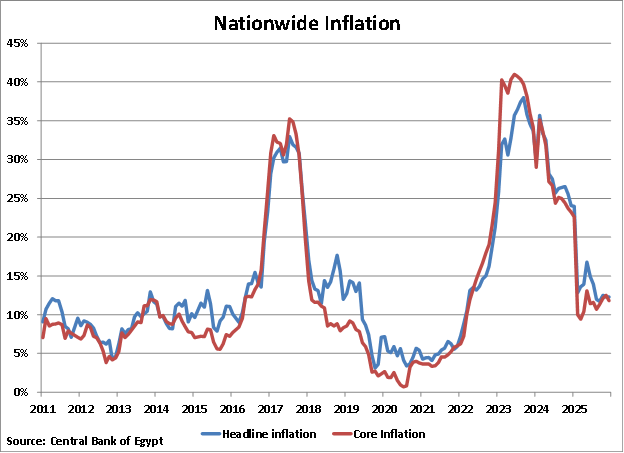
In December 2025, the country’s headline inflation was 12.3%, unchanged from the previous month but far lower than the 24.1% recorded in the same period last year, based on figures from CAPMAS. Likewise, core inflation also declined to 11.8% in December 2025, down from 12.5% in the previous month and from 23.2% in the preceding year. Despite the sharp deceleration in recent months, inflation remains far above the central bank’s target of 7% with a two-percentage-point tolerance band.
The government’s finance program boosts mortgage market growth
The Egyptian mortgage market dates back to 2001, when Presidential Decree No. 277 created the Mortgage Finance Authority (MFA). But market development has been slow in the past two decades, and currently, Egypt’s mortgage market is equivalent to less than 1% of the country’s GDP, according to Mona El-Baradei of the Egyptian Banking Institute.
Encouragingly, the mortgage market is now expected to accelerate, driven by sustained government initiatives aimed at expanding housing finance and improving affordability. The number of mortgage finance companies (MPC) operating in Egypt increased from only 2 in 2005 to 27 recently. These include Sakan, Al-Qula, EHFC, Egyptian Housing Finance Co., EMRC, Amlak, Al-Tayasor, Tamweel, Tamweel Emirates, Naeem, Al-Ahly, Arab African International, Al-Ahly United, and El Masreyin, according to the Egyptian Financial Supervisory Authority (EFSA).
To address the housing shortage, the CBE launched a mortgage finance program in 2014 to finance low-income housing projects, allocating EGP 20 billion (US$425 million) to banks in the form of deposits to benefit low-income citizens.
In February 2016, the program was expanded to increase the number of beneficiaries and to add a new segment of low-income citizens at a lower interest rate of 5%. In addition, above-middle-income citizens were also included at an interest rate of 10.5%.
Earlier in 2016, the CBE allocated EGP500 million (US$10.61 million) to mortgage companies for the first tranche of the program. Moreover, 14 banks provided EGP 5 billion (US$106 million) to finance 62,000 housing units as part of the program, according to Mai Abdel Hamid, the head of the Mortgage Finance Fund.
In March 2020, the World Bank approved a loan for Egypt’s Mortgage Finance Fund worth US$500 million to finance the country’s social housing programs.
To help struggling borrowers during the onset of the Covid-19 pandemic, the government temporarily reduced interest rates from its mortgage finance program and ordered MPCs to provide a six-month grace period to any client on request.
Then in 2021, President Abdel Fattah al-Sisi directed the CBE to launch a new mortgage funding program for low- and middle-income individuals with long-term loans of up to 30 years and with low and simplified interest rates not exceeding 3%.
As of November 2025, the total funds disbursed reached around EGP 95.53 billion (US$2.03 billion), benefiting a total of 668,504 low-income individuals. Of which, the contribution of 22 banks that participated in the government’s mortgage finance program for low-income housing amounted to EGP 88.78 billion (US$1.88 billion) for 636,842 customers. This represented approximately 92.9% of the initiative’s total funding, according to the Social Housing and Mortgage Finance Fund.
Banks also extended EGP 4.25 billion (US$90.23 million) in financing to 11,844 middle-income borrowers.
Meanwhile, mortgage finance companies contributed an additional EGP 2.45 billion (US$52.01 billion) in loans to 19,304 low-income beneficiaries, accounting for around 2.6% of the initiative’s total disbursements. These companies also provided EGP 61.85 million (US$1.31 million) in financing to 514 middle-income clients.
The 10 banks with the biggest contribution by November 2025 included:
- National Bank of Egypt (NBE): EGP 21.28 billion (US$451.9 million), equivalent to 23.3% marketshare, benefiting 163,416 individuals
- Banque Misr: EGP 20.75 billion (US$440.5 million), equivalent to 22.7% share, benefiting 152,388 customers
- Banque du Caire: EGP 10.31 billion (US$218.8 million), representing about 11.3% share, benefiting 65,913 individuals
- Housing and Development Bank (HDB): EGP 7.95 billion (US$168.8 million), equivalent to 8.7% share, benefiting 76,329 customers
- QNBAlahli: EGP 6.79 billion (US$144.1 million) for 36,379 customers, accounting for approximately 7.4% share
- Commercial International Bank (CIB): EGP 5.74 billion (US$121.8 million) for 32,210 clients, capturing around 6.3% market share
- Al AhliUnited Bank: EGP 2.42 billion (US$51.3 million), equivalent to 2.6% share, benefiting 16,079 individuals
- Bank NXT: EGP 2.3 billion (US$48.9 million) for 12,052 clients, capturing 2.5% market share
- Industrial Development Bank: EGP 2.16 billion (US$45.8 million), equivalent to 2.4% share, benefitting 18,372 individuals
- Mashreq Bank: EGP 1.39 billion (US$29.6 million) provided to 7,896 clients, representing 1.5% market share
Economic and Social Factors
Egypt’s economic conditions improving gradually
Egypt has successfully weathered the adverse impact of the Covid-19 pandemic, with its real GDP rising by 3.5% in 2020 and by another 3.3% in 2021. In fact, Egypt was the only nation in the MENA that avoided negative GDP growth during the onset of the pandemic. The economy expanded by a healthy 4.3%, on average, in the past decade, as various economic reforms have successfully buoyed business investment and private consumption in the country.
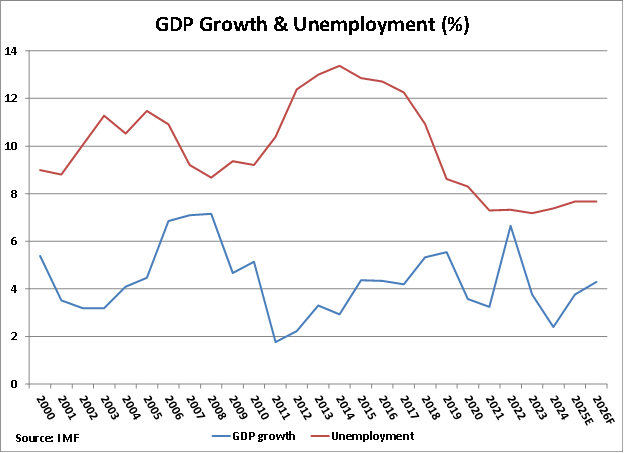
After growing by 6.7% in 2022, Egypt’s economic growth moderated to 3.8% in 2023. Then in 2024, economic growth slowed further to 2.4%, due to disruptions from the Gaza conflict, a sharp drop in Suez Canal revenues, declining oil and gas output, and high inflation caused by currency depreciation and subsidy cuts. Austerity measures tied to IMF reforms also contributed to the slowdown.
But conditions have since improved as the government accelerated economic reforms. In February 2024, Egypt secured a US$24 billion investment agreement with the United Arab Emirates’ sovereign wealth fund, including a major land development deal on the Mediterranean coast, followed by an expanded US$8 billion programme with the International Monetary Fund (IMF) in March 2024.
During the FY 2024/25, Egypt recorded an economic growth rate of 4.4%, according to Rania Al-Mashat, Minister of Planning, Economic Development, and International Cooperation.
Then in the first quarter of FY 2025/26, Egypt’s economy expanded by 5.3%, marking the fastest growth in over three years and significantly higher than the 3.5% recorded a year earlier, according to preliminary estimates from the Planning Ministry. The robust performance is credited to ongoing economic and structural reforms, which have strengthened key sectors including non-oil manufacturing, tourism, and telecommunications.
Planning Minister Rania Al-Mashat said Egypt is targeting economic growth of around 5% for the fiscal year ending June 2026, up from a previous target of 4.5%. This outlook aligns with the IMF, which has recently revised its growth forecast for Egypt upward to 5.4% in FY 2026/27, citing improving economic indicators.
Egypt’s budget deficit stood at 7.55% of GDP in 2025, from 7.1% in 2024, 5.7% in 2023, 6.1% in 2022, 7.2% in 2021, and 7% in 2020, according to the Ministry of Finance.
The Egyptian government approved a budget amounting to EGP 4.6 trillion (US$97.7 billion) for FY2025-26, an increase of 18% from the previous fiscal year. It estimated revenues of around EGP 3.1 trillion (US$65.8 billion), up by 19% from the earlier fiscal year, with a projected deficit of EGP 1.5 trillion (US$31.8 billion).
Public debt was estimated at around 80.95% of GDP last year, from 82.9% in 2024 and 95.8% in 2023.
The labour market remains resilient. In Q3 2025, the nationwide unemployment rate stood at 6.4%, up from the record-low of 6.1% in the previous quarter but lower than the 6.7% seen in the same period last year, according to CAPMAS. It was one of the lowest jobless rates recorded in the country in recent history.
Egypt’s unemployment rate averaged 10.1% from 2000 to 2024, according to the IMF.
In December 2025, the headline inflation was 12.3%, unchanged from the previous month but far lower than 24.1% recorded a year earlier, based on figures from CAPMAS. Despite the sharp deceleration in recent months, inflation remains far above the central bank’s target of 7% with a two-percentage-point tolerance band. Headline inflation had been extraordinarily high in the past three years, reaching a record high of 38% in September 2023, mainly due to a weaker Egyptian pound after a series of devaluations in recent years.
Core inflation stood at 11.8% in December 2025, down from 12.5% a month earlier and far lower than the 23.2% seen in the preceding year.
Sources:
- Egypt Real Estate Demand Index (Aqarmap): https://index.aqarmap.com/
- Real estate prices in Egypt (Aqarmap): https://aqarmap.com.eg/
- Cairo Living Market Dynamics, Q3 2025 (JLL): https://www.jll.com/
- IMF Executive Board Approves 46-month US$3 billion Extended Arrangement for Egypt (International Monetary Fund): https://www.imf.org/
- Egypt’s Devaluation and Record Rate Hike Put IMF Deal in Reach (Bloomberg): https://www.bloomberg.com/
- So why is Egypt building a new capital city right next to Cairo? (City Monitor): https://www.citymonitor.ai/
- New Administrative Capital (Britannica): https://www.britannica.com/
- Why Egypt’s President Sisi is rushing to embrace the nation’s youth (The Christian Science Monitor): https://www.csmonitor.com/
- Inflation Rates Historical Data (Central Bank of Egypt): https://www.cbe.org.eg/
- Monthly Interest Rates Historical Data (Central Bank of Egypt): https://www.cbe.org.eg/
- Discount Rates (Central Bank of Egypt): https://www.cbe.org.eg/
- Gross rental yields in Egypt: Cairo and 2 other cities (Global Property Guide): https://www.globalpropertyguide.com/
- MPC decides to cut key policy rates by 100 basis points (Central Bank of Egypt): https://www.cbe.org.eg/
- Egypt, Inclusive Housing Finance Program-for-Results, Additional Financing (World Bank): https://www.worldbank.org/
- Egypt: 22 banks offer $1.75bln in mortgage finance for low-income housing in February 2023 (Zawya): https://www.zawya.com/
- Subsidised mortgage finance for low- and middle-income borrowers reach EGP 95.5bn in November 2025 (Daily News Egypt): https://www.dailynewsegypt.com/
- Egypt to implement healthcare system nationwide within 10 years: Finance minister (AhramOnline): https://english.ahram.org.eg/
- The road to Universal Health Coverage in Egypt: New expectations and hopes (International Health Policies): https://www.internationalhealthpolicies.org/
- Egypt GDP Annual Growth Rate (Trading Economics): https://tradingeconomics.com/
- Egypt records 5.3% growth in early FY2025/2026 as economy gains momentum (State Information Service): https://sis.gov.eg/
- Arab Republic of Egypt (International Monetary Fund): https://www.imf.org/
- Egypt's GDP grew by 5.3% in the first quarter of 2025/2026 (Reuters): https://www.reuters.com/
- IMF raises Egypt's economic growth outlook to 5.4% for FY 2026/27 (Daily News Egypt): https://www.dailynewsegypt.com/
- Egypt Government Budget (Trading Economics): https://tradingeconomics.com/
- Egypt Approves Budget for FY2025-26 Amidst IMF Pressure (Middle East Briefing): https://www.middleeastbriefing.com/
- Egypt Government Debt to GDP (Trading Economics): https://tradingeconomics.com/