Pandemic interrupts Nigeria’s housing boom
2019 was a great year for Nigeria’s housing market, with demand rising by double-digit figures. Property listing enquiries surged 72%, according to a year-ender report by Nigeria Property Centre.
However due to the pandemic, demand suddenly slowed this year. Job losses and salary cuts have prevented many from renting better apartments or purchasing new homes, note PropertyPro.ng. Estate Intel confirms that “many payment plans for properties are being extended”.
Despite this, local real estate experts remain optimistic. “A section of the workforce who now work remotely may have an increased need for larger spaces,” said PropertyPro.ng. “Specifically for millennials looking for improved privacy, the need for new apartments will probably surface.”
In an effort to buoy economic activity amidst the pandemic, the Central Bank of Nigeria (CBN) recently approved NGN 200 billion (US$ 520 million) in mortgage finance to fast track construction of 300,000 social housing units for low-income households, and to create new jobs for the unemployed.
In Q2 2020, Nigeria’s economy shrank by 6.1% from a year earlier, in contrast to a 1.9% growth the previous quarter, amidst subdued domestic and international economic activity due to the nationwide shutdown measures aimed at containing the pandemic, according to the National Bureau of Statistics. It was the steepest decline since Q1 2004. The International Monetary Fund (IMF) recently revised down its 2020 economic forecast for Nigeria to a contraction of 5.4%, worse than its earlier estimate of -3.4%.
Local house price variations
Lagos is the most expensive city in Africa. In Ikoyi, the average price of three-bedroom apartments was NGN 150 million (US$393,700) in H1 2020 while five-bedroom apartments are sold for an average price of NGN 450 million (US$1.18 million).
In other popular areas outside Lagos:
- Abuja, the capital city of Nigeria, is experiencing increasing interest from both local and foreign investors. In Maitama, an upscale neighborhood in Abuja, the average price of four-bedroom apartments was NGN 2oo million (US$519,575) while five-bedroom apartments were sold for NGN 365 million (US$948,224) in H1 2020, according to PropertyPro.ng.
- In Ibadan, the capital and most populous city of Oyo State, the average price of four-bedroom apartments range from NGN 71 million (US$184,449) in Alalubosa to NGN 25 million (US$64,947) in Akala Express.
- In Rivers, the average prices of three- and five-bedroom apartments were NGN 40 million (US$103,915) and NGN 75 million (US$194,840), respectively.
- In Ogun, the average price of three-bedroom apartments stood at NGN 11.5 million (US$298,756) while it was NGN 30 million (US$77,936) for five-bedroom apartments.
AVERAGE PRICES OF 4-BR HOUSES IN LAGOS, SEPTEMBER 2020 |
||
| Area | NGN | USD* |
| Ikoyi | 343,110,000 | 891,357 |
| Ibeju Lekki | 24,970,000 | 64,869 |
| Lekki | 69,310,000 | 180,059 |
| Ajah | 41,940,000 | 108,955 |
| Gbagada | 54,140,000 | 140,649 |
| Surulere | 44,370,000 | 115,268 |
| Yaba | 54,470,000 | 141,506 |
| Victoria Island | 126,430,000 | 328,449 |
| Isolo | 43,320,000 | 112,540 |
| Alimosho | 25,070,000 | 65,129 |
| Ikeja | 86,370,000 | 224,378 |
| Ikorodu | 17,310,000 | 44,969 |
| *Exchange rate: NGN 381 = USD 1 Sources: Nigeria Property Centre, Global Property Guide | ||
Foreign homeownership rules
Foreigners can obtain leases from the State for a maximum of 99 years for the use of land.
A peculiarity about purchase of property in Nigeria, particularly in Lagos, is the Consent Fee. The Land Use Act of 1978 converted all land to State Land. Therefore, land cannot be owned privately. Formally, the state government is the owner of land and therefore any change in ownership or assignment, in case of a lease, should have the consent of the Governor. The consent of the Governor of the State is needed for the assignment of title to use, occupy, and improve property with a statutory certificate. This certificate does not include rights to sell, give, or sub-let, which requires further consent from the State Governor.
Sale of real estate does not involve actual selling and purchasing. There is only the transfer of rights from one person to another. This transaction is usually called an ‘assignment’. The seller assigns the rights to use and occupy the land to the buyer. After the transaction, the buyer applies for a new (statutory) certificate under his name. In this case, the seller acts as the assigner, and the buyer is the assignee.
So before purchasing, it is important to make sure that consent from the Governor is obtained for the sale. No land can be "sold" without this consent.
Africa’s most ambitious real estate development ever!
Eko Atlantic City is one of the most ambitious real estate development projects ever undertaken in Africa - a megacity that will provide new homes for 250,000 people and office space for another 150,000 people, simultaneously protecting the coastline and solving Lagos’ chronic shortage of quality housing.
It is being constructed on land reclaimed from the ocean adjoining Lagos’ Victoria Island district and the Phase 1 area of Lekki, and covers around 10 million square metres (10 square kilometres).
It is planned to have a positive environmental impact, as it will help stop the erosion of Lagos State’s coastline, though there are criticisms, with some alleging that construction is encouraging storm surges. Private companies and investors are providing the funding, while Lagos State Government is a strategic partner, with the support of the Federal Government.
Land prices in Eko Atlantic have nearly doubled since construction began in 2008. Currently, they are about 40% more than the land values in its close neighborhoods.
Other residential property developments in the country include the following (according to PropertyPro.ng):
- 4 Bourdillon – a 25-storey twin towers that is set to become the tallest residential building on the shores of Lagos. Located in one of Ikoyi’s most prestigious location, Bourdillon Road, Infinite Towers is set to offer 41 units of duplex flats and duplex penthouses. A four-bedroom apartment costs around US$2.35 million.
- The Benmonte – a 20-floor luxury residential development located at 40 Bourdillon Road in Ikoyi, Lagos, offering a mix of apartments, duplexes and penhouses.
- Overlook Condominiums – a luxury American style condominium development situated between the prominent Ikoyi Club Golf Course and the Lagos Polo Club. It comprises of 31 luxury condos, including 2 and 3 bedroom flats and 3 bedroom duplexes.
- Seattle Court – a 6-storey prime residential waterfront development in the diplomatic enclave of Walter Carrington, Victoria Island. The development offers 24 luxury apartments.
Yields in Lagos are moderate
The average yield on Lagos Mainland residential property is around 4.30% per annum, while the average yield on Lagos Island is around 3.64% per annum, according to the Residential Auctions Company (RAC). Yields have generally been significantly higher on the Lagos Mainland except in 2010, when Lagos Island yields were marginally higher.
That’s because Lagos Island has seen stronger rises in prices than Lagos Mainland, with surging demand for luxury houses.
In Ikoyi, Lagos, the average rent for a four-bedroom apartment was NGN14 million (US$ 36,745) annually in H1 2020, up from NGN 9.5 million (US$ 24,934) in 2018, according to PropertyPro.ng.
In Victoria Island, four-bedroom apartments are offered for about NGN 4.5 million (US$ 11,811) per year while in Ikeja a similar property is rented for NGN 3.75 million (US$ 9,843).
Interest rates are falling
In September 2020, the Central Bank of Nigeria (CBN) cut its benchmark interest rate by 100 basis points to 11.5%, the lowest level since 2016 - the second rate cut this year.
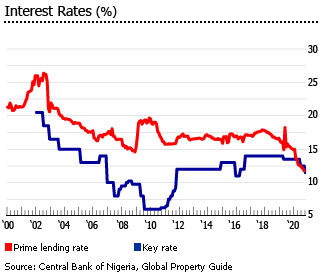
As a result, the prime lending rate fell to 11.76% in August 2020, from 15.4% in the same period last year.
Prime lending rates for mortgage loans ranged from 7% to 27% in September 11, 2020, still high but a significant decline from a year earlier, based on a survey conducted by the central bank.
| AVERAGE MORTGAGE RATES (%), SEPTEMBER 2020 | ||
| Banks | Prime (%) | Max (%) |
| Access Bank | 14.00 | 29.00 |
| Citi Bank Nigeria | 12.00 | 22.00 |
| Ecobank | 19.00 | 28.00 |
| First Bank of Nigeria | 12.00 | 26.00 |
| FBN Merchant | 16.50 | 16.50 |
| FCMB | 17.50 | 30.00 |
| Fidelity Bank | 19.00 | 36.00 |
| FSDH | 9.63 | 22.00 |
| Guaranty Trust Bank | 14.00 | 22.50 |
| Heritage Bank | 27.00 | 30.00 |
| Keystone Bank Ltd | 21.00 | 34.00 |
| Nova Merchant Bank | 14.00 | 20.00 |
| Providus Bank | 18.00 | 30.00 |
| Standard Chartered Bank | 14.00 | 25.00 |
| Polaris Bank | 11.75 | 30.00 |
| Stanbic IBTC | 10.26 | 30.00 |
| Sterling Bank | 24.00 | 30.00 |
| Suntrust | 7.00 | 10.00 |
| Titan Trust Bank | 13.50 | 20.00 |
| United Bank for Africa | 20.00 | 24.00 |
| Union Bank | 24.50 | 20.50 |
| Unity Bank | 26.00 | 28.00 |
| Wema Bank | 25.00 | 30.00 |
| Zenith Bank | 13.66 | 30.00 |
| Source: Central Bank of Nigeria | ||
Acute housing deficit
Nigeria has limited lots under formal title and even quality housing can often not be mortgaged, so that the formal housing market serves only the minority, according to Centre for Affordable Housing Finance in Africa (CAHF).
Nigeria’s housing deficit has worsened over the past three decades, and the housing deficit is now over 17 million according to the PwC, up from 14 million in 2010, 12 million in 2007 and 7 million in 1991. Based on a World Bank report, the country needs about 700,000 additional units each year for the next 20 years to keep up with growing population and urban migration. However housing construction is now only about 100,000 units per year.
In Lagos, Nigeria’s largest urban area, about 70% of the total population currently lives in informal housing and slums, based on figures from Lagos State authorities. The housing deficit in Lagos is estimated to be around 2.5 million units. In major centres such as Lagos, Abuja, Ibadan and Kano housing demand is growing at about 20% per year.
To abate the situation, the Lagos State Government plans to build 187,000 housing units every year over the next five years. In 2016, the Lagos State Government began implementing its Rent-To-Own programme in five estates built under the Lagos Home Ownership Mortgage Scheme: the Sir Michael Otedola Housing Estate, Odoragunshin, Epe; CHOIS City, Agbowa; Oba Adegboruwa Estate Igbogbo, Ikorodu; Alhaja Adetoun Mustapha Estate, Ojokoro; and Hon. Olaitan Mustapha Estate, Ojokoro.
Recently, the Nigerian government also established the Family Homes Funds (FHFL), a social housing initiative that aims to invest up to NGN 1.3 trillion (NGN 3.4 billion) in the development of 500,000 homes for low-income households by 2024, as well as the creation of 1.5 million new jobs.
Moreover, the government is looking at the possibilities for partnering with private real estate developers. “When the private sector is involved and a conducive environment is there, necessary laws that will encourage housing development, I can assure you that the job will be easy for us to do,” said real estate consultant Barrister Festus Adebayo.
Challenges facing the property market
Three main structural challenges face Nigeria’s property market:
1. Property registration is expensive. Land titles are prone to political interference because of the vast powers of governors over state land allocation. Bottlenecks inevitably arise in the property transfer system due to Nigeria’s federal structure.
Another hindrance is that 65% to 70% of land is still held under customary title. Even in areas where title deeds are more common, there can be difficulties in clarifying who actually holds title to the land. This title uncertainty often means endless challenges in court.
Nigeria is among the worst globally when it comes to registering property, according to the World Bank’s Doing Business 2020 report, which ranks it at 183rd out of 190 countries. In Lagos, the registration process can last an average of 105 days, taking an average of 12 procedures, and costing about 11.1% of the value of the property. Neighboring Ghana only requires 5 procedures, 33 days and 6.1% of the property value.
The cost of registering property in Nigeria is about 70% higher than the average for Sub-Saharan Africa and almost three times the OECD average. In South Africa, similar land registrations are completed in much shorter times and cost only 8% of the property value.
2. Housing construction handicapped by high costs. Building a house is very expensive in Nigeria. A three-bedroom house, for example, will cost about US$50,000, compared to US$36,000 in South Africa and US$26,000 in India, according to Finance Minister Ngozi Okonjo-Iweala.
The cost of construction is high for three reasons: high costs of building materials, high skilled labour costs, and costs associated with poor roads and sewerage systems.
About 75% of dwellings in Nigeria’s urban areas are built of concrete. Cement prices in Nigeria are about 30-40% higher than in neighboring countries and world market prices. The lack of public infrastructure adds as much as 30% to the total costs of the development.
3. Few can access mortgage finance. Only about 5% of the 13.7 million housing units in Nigeria are financed with a mortgage, and the mortgage debt to GDP ratio is only about 1%, and mortgage loans account to less than 1% of commercial banks’ total assets (specialist mortgage banks accounted for about 57% share of the market, according to the Central Bank of Nigeria.
Only 2% of Nigerians over 15 years old have a loan from a financial institution, and a meagre 0.6% have an outstanding loan for home purchase. Loans for home construction are more common, although still minuscule, at 1.7% overall, according to World Bank’s Global Financial Inclusion (Global Findex) Database. Though the government set financial inclusion as a key pillar of its ‘Financial System Strategy 2020’, the challenges are huge, including low literacy, high interest rates, rising inflation, and high poverty.
The Federal Mortgage Bank of Nigeria (FMBN) manages a National Housing Fund financed mostly by contributions from public sector workers. In 2016, the FMBN introduced a scheme offering a housing loan up to NGN15 million (US$39,100) to all interested Nigerians. However, before one can qualify, the borrower must make monthly contributions over a period of six months and make a downpayment of 15% of the value of the property.
Housing development agencies in various state governments have had very limited impact.
“The ecosystem for residential investment development still remains relatively broken. The lack of affordable mortgages is a major challenge, a major deterrent, a major hindrance to the development of residential properties in this market,” said Michael Chu’di Ejekam, Director of Nigerian Real Estate at Actis, a London-based private equity firm.
Insurgencies have hit the north’s property market
The Islamist insurgency in Nigeria started in 1999 with the establishment of Sharia law in several Muslim-majority states in the north. Tensions between Christians and Muslims resulted in thousands of killings, with deaths sharply increasing in recent years.
Terrorist activities have scaled up in recent times. According to UNICEF, Boko Haram has kidnapped more than 1,000 children in northeastern Nigeria since 2013. Fighting escalated in late 2014, with Boko Haram militants attacking and seizing several northern Nigerian towns. The militants seized control of Bama in late 2014, attacked the towns of Baga and Maiduguri in January 2015, captured Gwoza in March 2015 and Sambisa forest in April 2015, and raided three villages in Borno in July 2015.
In February 2018 110 high school students were abducted in the northeast town of Dapchi. Despite President Muhammadu Buhari’s promise to stop the killings, in June 2020, at least 81 people were killed in an attack on a village in northeast Nigeria, with 7 people kidnapped. This followed another attack in February 2020, where about 30 people died after suspected Boko Haram militants set fire on sleeping travelers in Borno state. Since 2009, the insurgency has killed more than 15,000 people and forced around 2 million people from their homes.
“Unarguably, people are moving down south. The insurgency is really affecting the construction industry negatively,” said Fred Akinloye, former chairman of Nigerian Institution of Estate Surveyors and Valuers (NIESV) Kano State Chapter. “Property values have gone down considerably because demand is very low.”
“The [property] vacancy rate is as high as 30 percent in Yobe, Adamawa, Borno, Katsina and Kano,” according to online newspaper BusinessDay.
Though the government has retaken most areas held by the group, including its stronghold Camp Zero in Sambisa forest, violent encounters and suicide bombings have actually increased. An estimated 4.4 million people in northeast Nigeria are in need of food assistance, medical care, and shelter, according to Ertharin Cousin, the executive director of World Food Programme (WFP).
Efforts to spur housing sector
Nigeria’s property market, especially the Lagos market, has been improving in terms of transparency and ease of doing business, according to Jones Lang LaSalle’s Global Real Estate Transparency Index. In 2020, Nigeria ranked 68th among the 99 markets, up 15 notches from 83rd in 2016.
In 2012, then President Goodluck Jonathan convened a Roundtable on the Housing Sector, and the Nigeria Mortgage Refinance Company (NMRC) was the outcome.
Established with US$300 million from the World Bank, the NMRC provides mortgage lending banks with increased access to long-term funds. The agency expects to facilitate more than 450,000 loans for low-cost housing units over the next five years.
Computerized land registries have also been introduced in Lagos and Abuja to address the lengthy registration process.
Struggling economy, surging unemployment
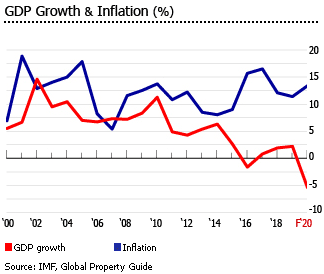
In Q2 2020, Nigeria’s economy shrank by 6.1% from a year earlier, in contrast to a 1.9% growth in the previous quarter, amidst subdued domestic and international economic activity due to the nationwide shutdown measures aimed at containing the pandemic, according to the National Bureau of Statistics. It was the first decline since Q1 2017 and the steepest since Q1 2004.
On a quarterly basis, Nigeria’s GDP contracted by 5% in Q2 2020, following a 14.3% plunge in the previous quarter.
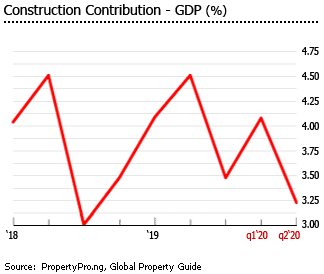
The oil sector declined by 6.6% y-o-y in Q2 2020, following a 5.1% growth in Q1, amidst lower crude oil production. Similarly, the non-oil sector recorded a decline of 6.1%, as the coronavirus crisis hit critical activities such as transportation, food services, construction and internal trade.
Nigeria’s economy grew by 2.2% in 2019, an improvement from expansions of 1.9% in 2018 and 0.8% in 2017 and a contraction of 1.6% in 2016, buoyed by improvements in manufacturing and services, as well as a recovery in the oil sector.
Recently, the International Monetary Fund (IMF) revised down its 2020 economic forecast for Nigeria to a contraction of 5.4%, worse than its earlier estimate of -3.4%, amidst larger-than-expected disruptions to global value chains due to the pandemic.
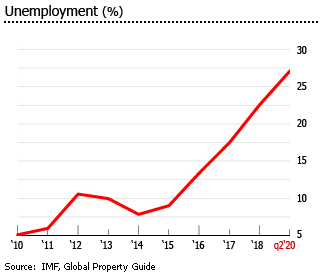
Unemployment is rising sharply. In Q2 2020, the overall unemployment rate stood at 27.1%, the highest level on record. It was the first time since 2018 that the country’s National Bureau of Statistics published such figures. Unemployment averaged just 8.8% from 2010 to 2016, before rising to 13.4% in 2017 and 22.6% in 2018, according to the IMF.
Youth unemployment was very high, at 34.9% in Q2 2020.
In August 2020, inflation stood at 13.22%, the highest level since March 2018, as food prices surge amidst the COVID-19 pandemic, based on figures from the NBS. After an annual average of 10% from 2006 to 2015, inflation climbed to almost 14% every year from 2016 to 2019.
“Specifically, headline inflation is expected to hover around 13.97% and 14.15% at end-December 2020,” said the country’s central bank, due to food supply shocks that may occur emanating from a decline in economic activities worldwide and from domestic and international lockdowns.
To alleviate the situation, the government approved a stimulus package worth NGN 2.3 trillion (US$ 6 billion) in June 2020 to support the most vulnerable sectors adversely impacted by the coronavirus outbreak. Earlier, Nigerian President Muhammadu Buhari signed an ambitious budget into law, amounting to a record NGN 10.8 trillion (US$ 28.2 billion), in an effort to boost the economy and increase its expenditure on security to help the government combat rising militancy and kidnapping across the country.
Buhari won a second term in the February 2019 elections, defeating his pro-business rival Atiku Abubakar who had pushed for privatizations and a shift towards a free-floating exchange rate regime.
Nigeria’s “rebased” GDP; multiple exchange rate system
Nigeria’s economy is now visibly the largest in Africa after it “rebased” its gross domestic product (GDP) for 2013, from US$270 billion to about US$515 billion. That compares with South Africa’s GDP of US$367 billion and Egypt’s GDP of US$285 billion at the end of 2013.
While the revised figure makes Nigeria the 26th biggest economy in the world, the country lags behind in terms of income per capita, with US$2,222 for each citizen in 2019 - compared to South Africa’s income per capita of US$6,100.
The rebasing of Nigeria’s GDP has boosted interest from international property developers and foreign homebuyers to invest in the country´s real estate market.
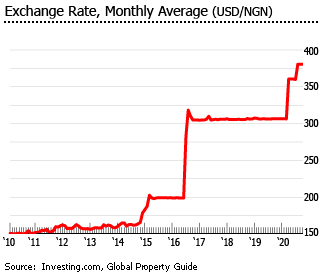
However, since the peg to the US dollar was abolished in June 2016, the Naira has been falling sharply, resulting to a contraction in the overall size of the economy. In 2019, Nigeria’s GDP stood to just about US$446 billion. After maintaining an exchange rate of NGN 197 = USD 1 for about 16 months, Nigeria’s central bank decided to move to a multiple foreign exchange policy to alleviate the chronic foreign currency shortage after the 2014 crash in oil prices. In just seven months, the Naira lost about 38% of its value.
In September 2020, the official exchange rate stood at an average of NGN 380.6 = USD 1, losing about 19.5% of its value from a year earlier. However, the convertible Investors and Exporters window, to which the parallel market rate remains aligned, usually trades at about 20% premium over the official exchange rate.
Recently, the IMF noted that the existence of multiple exchange rates creates distortions in the economy and discourages foreign investment. The international organization called for a unified market-based exchange rate and greater flexibility on a more permanent basis to support inflation targeting, shield the economy from external shocks and improve the country’s trade competitiveness.
Widespread corruption and poverty under Baba Go Slow
President Muhammadu Buhari was elected in 2015 on a wave of hope that he could defeat Boko Haram Islamists and turn around a country blighted by decades of high unemployment and poverty, crime, corruption and poor governance. During his first election campaign, he vowed to fight against corruption and insecurity if elected, and the anti-graft war has been one of his topmost priorities.
But though he was Nigeria’s first opposition candidate to defeat an incumbent, and recently won a second term, questions have often arisen about his fitness to govern. He has frequently been abroad for medical treatments, sparking one of politics’ more unusual conspiracy theories -- that he had died and been replaced by a lookalike from Sudan.
Some critics have focused less on his physical frailties and more on his mental faculties. After US President Donald Trump reportedly called him "lifeless" after the recovering Buhari visited Washington, his critics were delighted. After an appearance in a live televised question-and-answer session in January 2019, one commentator called Buhari "intellectually disabled".
Critics, who gave Buhari the nickname "Baba Go Slow" because it took him six months to appoint a cabinet, have continued to complain about his relaxed working style and for stacking his new cabinet in his final term with ageing party loyalists, instead of more technocrats. In fact in May 2020, Buhari was left red-faced after he appointed a man who died months ago to a top post – the sixth time that he committed such error. Nigeria’s lawyers have criticized his authoritarianism, suggesting that the anti-corruption campaign has been partial and favoured the ruling party.
Corruption is certainly a major problem. Based on a recent study conducted by PwC, corruption in Nigeria could cost up to 37% of GDP by 2030 if not dealt with. This cost is equivalent to about US$1,000 per person in 2014 and almost US$2,000 per person by 2030.
Poverty is also swelling. About 94 million Nigerians live on less than US$1.90 a day last year, more than in any other country. This is supported by a report by Brookings Institution which showed that Nigeria has already overtaken India as the world’s poverty capital. A 2020 report released by Nigeria Employers Consultative Association (NECA) showed that the number of citizens in extreme poverty now stands at about 102 million due to the coronavirus pandemic.
The northeast is in thrall to the Islamist terror organization Boko Haram. The police are abusive, violent, and corrupt. Power cuts are frequent, the roads ill-maintained. The press is under threat. The south periodically wonders whether it should separate from the chaotic north.
Colonized by the British, Nigeria gained its independence in 1960. The country’s oil industry boomed in the 1970s, making Nigeria Africa’s largest oil exporter. But with the world recession of the 1980s oil prices plunged, leading to a cycle of massive debt, soaring inflation, and large-scale unemployment.
Sources:
- 2019 Year in Review (Nigeria Property Centre): https://nigeriapropertycentre.com/blog/announcements/2019-year-in-review-nigeria-property-centre
- Average Price of Houses for Sale in Lagos (Nigeria Property Centre): https://nigeriapropertycentre.com/market-trends/average-prices/for-sale/houses/lagos
- Real Estate Market Report H1 2020 (PropertyPro.ng): https://www.propertypro.ng/real-estate-report/issue-q4/index-h5.html?page=1#page=24
- CBN approves N200 billion housing loan for 300,000 households at 5% per annum (Nairametrics): https://nairametrics.com/2020/09/16/cbn-approves-n200-billion-housing-loan-for-300000-households-at-5-per-annum/
- Nigerian Real Estate and COVID in 19 slides (Nairametrics): https://nairametrics.com/2020/07/15/nigerian-real-estate-and-covid-in-19-slides/
- Monetary Policy Decisions (Central Bank of Nigeria): https://www.cbn.gov.ng/MonetaryPolicy/decisions.asp
- Housing Finance in Nigeria (Centre for Affordable Housing Finance in Africa): http://housingfinanceafrica.org/countries/nigeria/
- Experts brainstorm on Nigeria’s housing deficit at 2020 Real Estate Outlook (Business Day): https://businessday.ng/real-estate/article/experts-brainstorm-on-nigerias-housing-deficit-at-2020-real-estate-outlook/
- SGF, Fashola divided over nation’s housing deficit (Nairametrics): https://nairametrics.com/2020/02/18/fg-divided-over-housing-deficit-as-the-number-rises-to-22-million/
- Nigeria: Overcoming Nigeria´s Huge Housing Deficit (AllAfrica): https://allafrica.com/stories/202008240148.html
- Nigeria Doing Business 2020 (World Bank): https://www.doingbusiness.org/content/dam/doingBusiness/country/n/nigeria/NGA.pdf
- Boko Haram Fast Facts (CNN): https://edition.cnn.com/2014/06/09/world/boko-haram-fast-facts/index.html
- Global Real Estate Transparency Index 2020 Rankings (JLL): https://www.us.jll.com/en/trends-and-insights/research/global-real-estate-transparency-index/greti-global-rankings-and-methodology
- Overview of the Nigeria Mortgage Refinance Company (Central Bank of Nigeria): https://www.cbn.gov.ng/out/2014/ccd/overview%20of%20the%20nigeria%20mortgage%20refinance%20company.pdf
- Nigerian housing sector responses to the COVID-19 pandemic: Nigeria Mortgage Refinance Company (Centre for Affordable Housing Finance in Africa): http://housingfinanceafrica.org/documents/nigerian-housing-sector-responses-to-the-covid-19-pandemic-nigeria-mortgage-refinance-company/
- USD/NGN - US Dollar Nigerian Naira (Investing.com): https://www.investing.com/currencies/usd-ngn-historical-data
- World Economic Outlook Database (International Monetary Fund): https://www.imf.org/en/Publications/WEO/weo-database/2020/April
- Nigerian Gross Domestic Product Report (Q2 2020) (National Bureau of Statistics): https://www.nigerianstat.gov.ng/elibrary
- Nigeria’s central bank paints grim economic outlook (Ventures Africa): http://venturesafrica.com/bat-exploits-south-africas-tobacco-troubles-shift-strategy/
- CPI and Inflation Report August 2020 (National Bureau of Statistics): https://nigerianstat.gov.ng/elibrary?queries[search]=inflation
- Fitch Revises Nigeria´s Outlook to Stable, Affirms at ´B´ (Fitch Ratings): https://www.fitchratings.com/research/sovereigns/fitch-revises-nigeria-outlook-to-stable-affirms-at-b-30-09-2020
- Nigeria At a Glance (International Monetary Fund): https://www.imf.org/en/Countries/NGA
- IMF expects Nigeria’s GDP to shrink by 5.4% in 2020 (International Monetary Fund): https://nairametrics.com/2020/06/25/imf-expects-nigerias-gdp-to-shrink-by-5-4-in-2020/
- Federal Government Approves N2.3 Trillion COVID-19 Stimulus Plan for Nigerians (Nigeria Business Information): https://www.naijabusiness.com.ng/news/2020/federal-government-approves-n2-3-trillion-covid-19-stimulus-plan-for-nigerians/
- IMF pressures Nigeria to fast track exchange rate unification (Nairametrics): https://nairametrics.com/2020/04/29/imf-pressures-nigeria-to-fast-track-exchange-rate-unification/
- Nigerians got poorer in Muhammadu Buhari’s first term (The Economist): https://www.economist.com/middle-east-and-africa/2019/05/30/nigerians-got-poorer-in-muhammadu-buharis-first-term
- Impact of Corruption on Nigeria’s Economy (PwC): https://www.pwc.com/ng/en/publications/impact-of-corruption-on-nigerias-economy.html
- Nigerian president appoints dead person to top government job – the SIXTH time he’s made the same mistake (The Sun): https://www.thesun.co.uk/news/11526139/nigeria-president-dead-man-sixth-time/
- Population of extremely poor persons in Nigeria hits 102m — NECA (Vanguard): https://www.vanguardngr.com/2020/10/population-of-extremely-poor-persons-in-nigeria-hits-102m-neca-2/