Madagascar - a poor, isolated, beautiful island
Why buy property in Madagascar, the world’s fourth largest island, and surely one of the most beautiful?
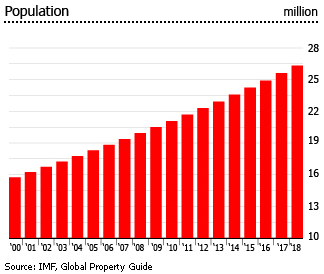
Off the coast of East Africa, it had an estimated population of 26.3 million in 2018. Its isolation in the Indian Ocean, with Comoros and Mozambique being its nearest neighbors, has allowed unique flora and fauna to flourish. There are roughly 200,000 species, a third of which exist nowhere else on the planet.
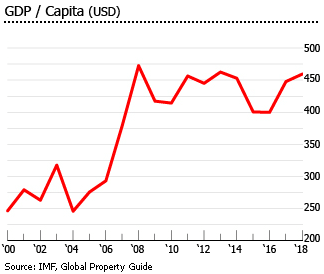
Residential developments are focused on the prime end of the market and the expatriate sector. The very low household income means that only a small portion of the population can afford to purchase a house. In 2018, GDP per capita was just US$459, making the country one of the poorest in the world, according to the International Monetary Fund (IMF). In fact, about 75% of its people live below the poverty line of US$1.90 per day. The electricity access rate, at 15.2%, is one of the lowest in Africa.
The most popular high-end residential areas are in and around Ivandry to the north of the city centre, where many of the embassies are located, according to a 2018 Knight Frank report.
A newly-built 70 sq. m. two-bedroom house just outside the capital city is currently priced about MGA 89 million (US$25,810), according to Africa Housing Finance Yearbook 2018. With a 15-year mortgage loan at 15% interest rate, monthly repayments would be around MGA 1.2 million (US$348), which is within the reach of only a small portion of the people.
Rampant corruption discourages investors and property developers. Madagascar is ranked 152 of 180 countries globally in Transparency International’s 2018 Corruption Perceptions Index. As such, it is not surprising that registering property is both costly and tedious. According to the World Bank’s Doing Business 2019, Madagascar is ranked 162nd out of 190 countries when it comes to registering property, down from 161st in 2018 and 159th in 2017. The registration process can last an average of 100 days, taking an average of 6 procedures, and costing about 9.1% of the value of the property. Madagascar is also among the worst in terms of dealing with construction permits, which is ranked at 183rd out of 190 countries.
Most property transactions are done in cash.
Foreigners can own land
In 2004, legislation that allowed foreigners to own land was passed. Foreigners must invest up to US$500,000 in real estate, banking, and tourism sectors, for them to own land up to 2.5 hectares, according to a report by USAID. A one-stop office was created to assist foreign investors in those sectors.
Another choice is to lease land, which is allowed for up to 99 years. Despite these quite liberal policies, foreigners still find it hard to invest in the country because of bureaucratic obstacles.
The economy grew by 5% in 2018, up from the prior year’s 4.2% growth and the biggest expansion since 2008, according to the African Development Bank. The economy is projected to expand by a robust 5.4% this year and by another 5.2% in 2020. However, Madagascar remains highly dependent on financial assistance from international donors.
High rental yields, low rents
Rental yields in a prime location in Antananarivo can go as high as 12%, according to Knight Frank LLP.
Rents are relatively low. Rents for one-bedroom apartments in the city centre of Antananarivo, Madagascar’s capital city, currently range from MGA 500,000 (US$145) to MGA 1.6 million (US$464) per month, according to Africa Housing Finance Yearbook 2018. Three-bedroom apartments in the same location may rent for MGA 1.8 million (US$522) to MGA 3 million (US$870) per month. However rents can go as high as MGA 5.5 million (US$1,500) for four to five-bedroom villas and executive homes in prime locations.
Outside the city centre, rental properties are typically 30% to 60% cheaper.
Small mortgage market; high interest rates
Currently, only about 2.5% of the total population has an outstanding housing loan at a bank or other financial institution.
Bank interest rates range from 9% to 24% and effective interest rates can go as high as 50%, making bank lending accessible only to a small portion of the population. In 2018, the average mortgage interest rate was 19%, according to Africa Housing Finance Yearbook 2018. The maximum loan term for land acquisition or home improvements is 8 years, while loans for house purchase or house construction range from 3 years to 20 years.
Banks offering housing-related loans include: BNI Madagascar; Bank of Africa Madagascar (BOA); BFV-Société Générale (BFV-SG); AccèsBanque Madagascar; Banque Malgache de L'ocean Indien (BMOI); BGFI Bank; and Mauritius Commercial Bank (MCB). There are also few microfinance institutions that are offering housing loans, including Baobab (formerly MicroCred), OtivTana, and Premiere Agence de Microfinance.
BNI Madagascar currently offers an interest rate of 15% plus 2.2% initiation fee for all housing-related loans, while BFV-SG charges 18% per annum. For Baobab, an interest rate of 3% per month is charged on loans on a declining balance with a once-off 2.4% administrative charge on new loans.
Registering property is both costly and tedious
The inefficiency of the property registration process is exacerbated by the number of government agencies and departments involved in the process, including the Property Registry, the Tax Authority, the Topographical Service and the Regional Planning Service, according to Africa Housing Finance Yearbook 2018.
The process of acquiring construction permits is equally costly and lengthy. Based on the World Bank’s Doing Business 2019 report, in terms of dealing with construction permits, Madagascar ranks 183rd out of 190 countries. There's no electronic database for checking encumbrances, no registry containing geospatial data on privately-held properties, and no national database to verify the accuracy of identity documents, according to Africa Housing Finance Yearbook 2018.
However, since 2014 the government has embarked on a pilot project to digitize existing land titles and, as of early-2018, about 65% of titles in the Avaradrano district were already digitized.
Over the past five years, the construction industry contributed almost 4% of GDP per year, which is roughly US$400 million annually.
Acute shortage of affordable housing
About 77.2% of urban households in Madagascar live in slums and most houses are self-built, temporary structures made with compacted mud and poorly attached thatched roofs.
The presence of public housing developers – Societe d’Equipement Immobilier de Madagascar (SEIMAD) and Agence Nationale d’Appui au Logement et a l’Habitat (ANALOGH) – does not help, as they have been unable to meet the increasing demand in the past several years. In 2016, ANALOGH announced it would build 500 social housing units annually in the next ten years. However as of February 2018, only 50 social housing units had been built.
Land reform
In 2004, the government launched a National Land Program. A 2005 Letter for Land Policy focused on four tasks, namely:
- Restructuring and modernizing land ownership and topographical records;
- Improving decentralized land management by establishing Land Management Offices at the sub-district level authorized to issue and manage land certificates based on locally established procedures;
- Updating the legislation to incorporate the principles of decentralized administration and to formalize local landholdings; and,
- Establishing a national land tenure training program to build local capacity.
Following the Letter for Land Policy, the government passed the 2005 Land Law (Law No. 2005-019), which classified land as state or private, described land tenure types, and provided procedures for land registration.
The following year, the government passed the 2006 Law on Untitled Private Property (Law No. 2006-031), permitting individuals claiming rights to untitled land to obtain certificates recognizing their rights. As of 2018, a total of 257,000 land certificate applications had been received, of which 142,000 were granted, according to Africa Housing Finance Yearbook 2018.
Economic growth accelerating, but political situation remains nervous
Since gaining independence from France in 1960, Madagascar has experienced repeated bouts of political instability, including coups, violent unrest, and disputed elections. In 2009 a coup led by Andry Rajoelina led to five years of political deadlock, economic sanctions and international condemnation, according to BBC News.
The return of democratic elections in 2013 and the election of Hery Rajaonarimampianina as president brought fresh hope. But he suffered a (failed) impeachment attempt, and then tried to debar rivals Marc Ravalomanana and Andry Rajoelina from standing against him in the November 2018 presidential election. Weeks of demonstrations and death of two protesters followed, and his predecessor Rajoelina won the November 2018 presidential elections.
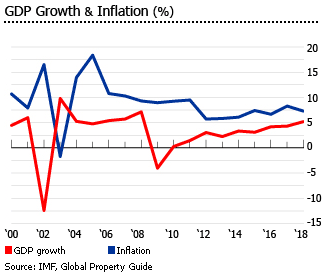
Madagascar’s economy is heavily reliant on agriculture. For almost half of the adult population, the main source of income is farming and farming-related activities. The economy was estimated to have grown by 5% in 2018, up from the prior year’s 4.2% growth and the biggest expansion since 2008, according to the African Development Bank.
The economy is projected to expand by 5.4% this year.
The budget deficit stood at 2.3% of GDP in 2018, slightly down from 2.4% of GDP in 2017. Public debt fell to 35.1% of GDP in 2018, from 38.4% two years ago.
Inflation was 7.3% in 2018, down from 8.3% in 2017 but still up from an annual average of 6.3% in 2012 to 2016, based on IMF figures.
Sources:
- Africa Housing Finance Yearbook 2018 (CAHF): http://housingfinanceafrica.org/app/uploads/Madagascar-2018-Final-1.pdf
- Doing Business 2019 Madagascar (World Bank): http://www.doingbusiness.org/content/dam/doingBusiness/country/m/madagascar/MDG.pdf
- World Economic Outlook Database (International Monetary Fund): https://www.imf.org/external/pubs/ft/weo/2019/01/weodata/index.aspx
- The Construction Sector in Madagascar 2018 - Company Opportunities & Success Influencing Factors (ResearchAndMarkets.com): https://www.businesswire.com/news/home/20180611006060/en/Construction-Sector-Madagascar-2018---Company-Opportunities
- Madagascar profile – Timeline (BBC News): https://www.bbc.com/news/world-africa-13864364
- Madagascar country profile (BBC News): https://www.bbc.com/news/world-africa-13861843
- Property Rights and Resource Governance Madagascar (USAID): http://admin.theiguides.org/Media/Documents/USAID_Land_Tenure_Madagascar_Profile.pdf
- Africa Report 2015 (Knight Frank): https://content.knightfrank.com/research/155/documents/en/africa-report-2015-2802.pdf
- Africa Report 2017/18 (Knight Frank): https://content.knightfrank.com/research/155/documents/en/africa-report-201718-4576.pdf
- Madagascar Economic Outlook (African Development Bank): https://www.afdb.org/en/countries/southern-africa/madagascar/madagascar-economic-outlook/
- Corruptions Perception Index 2018 (Transparency International): https://www.transparency.org/cpi2018
- Overview of corruption and anti-corruption in Madagascar (Transparency International): https://knowledgehub.transparency.org/helpdesk/overview-of-corruption-and-anti-corruption-in-madagascar-1