Buying Property in France: Prices, Yields, and Taxes
Foreigners can buy property in France without major restrictions. Popular markets include Paris, Nice, Lyon, Bordeaux, and Marseille, with Paris being the most expensive at around €9,678 per square meter. Rental yields average about 4.84%, and investors should be aware of tenant-friendly regulations and transaction costs.
France’s housing market has shown steady long-term growth, though price momentum has slowed in recent years. Mortgage rates have stabilized at around 3%, supporting a gradual recovery in lending activity. Overall, the market remains relatively stable, characterized by high property values, moderate rental returns, and a regulated rental environment.
Table of Contents
- Can Foreigners Buy Property in France
- Best Cities and Regions to Invest
- Square Meter / Square Foot Prices
- Median Asking Prices
- Rental Yields and Rents
- Market Performance (Past and Present)
- Landlord and Tenant Laws
- Property Related Taxes
- Buying (and Selling) Costs
- Mortgage and Financing Options
1. Can Foreigners Buy Property in France?
Yes, but it depends on the country of origin. Foreigners in France may purchase real estate and land under the same terms as local citizens, with no significant legal differences in ownership rights. However, the process and requirements can vary by nationality. Citizens of European Union (EU) countries typically experience a more streamlined procedure with fewer bureaucratic steps, due to EU policies on free movement and settlement. Non-EU citizens do not face direct restrictions but may encounter a more complex process.
2. Best Regions and Cities to Invest
Paris
As the capital and cultural heart of France, Paris is a premier location for both residential and commercial real estate. Iconic neighborhoods such as the Marais, Saint-Germain-des-Prés, and the Latin Quarter are particularly popular for their rich history, vibrant lifestyle, and modern amenities. Paris offers a range of properties, from luxurious apartments to charming historic homes, making it a top choice for investors seeking both long-term appreciation and rental income.
Nice
Located on the French Riviera, Nice is renowned for its stunning beaches and Mediterranean climate. The Promenade des Anglais and Old Town (Vieux Nice) are prime areas for holiday homes, luxury villas, and investment properties. With a thriving tourism industry, Nice attracts both tourists and real estate investors looking for lucrative rental opportunities.
Lyon
As France's third-largest city, Lyon is known for its culinary scene and rich cultural heritage. Key districts like Vieux Lyon and the Presqu'île are sought after for residential properties and investment opportunities. Lyon's strong economy, vibrant arts scene, and excellent transport links make it an attractive destination for both local and foreign investors.
Bordeaux
Famous for its wine production, Bordeaux is experiencing a real estate boom. The city’s historical architecture, along with its vibrant lifestyle and growing tech scene, make it a desirable location for investors. Areas like Chartrons and Les Halles offer a mix of charming homes and modern apartments, appealing to both families and young professionals.
Marseille
As France's second-largest city, Marseille boasts a rich maritime history and diverse culture. The Old Port (Vieux-Port) and the trendy Le Panier district are popular for residential and commercial investments. With a strategic location on the Mediterranean, Marseille is becoming increasingly attractive to international investors seeking growth potential.
3. Square Meter / Square Foot Prices
Square-meter prices in France are at the higher end compared to those in other EU countries. Paris has the highest sqm prices out of all of France’s cities.
As of January 2026, square meter prices were as follows in France:
- Paris - €9,678
- Lyon - €5,234
- Bordeux - €4,698
- Strasbourg - €3,772
- Marseille - €3,545
- Toulouse - €3,523
- Montpellier - €3,480
- Nantes - €3,432
4. Median Asking Prices
France has the 7th-highest median asking price. As of December 2025, one-bedroom apartments ranged from €163,000 to €443,000.
One-bedroom prices as of December 2025 were as follows:
- Paris - €443,000
- Nice - €265,000
- Lyon - €239,000
- Bordeaux - €218,000
- Montpellier - €178,000
- Marseille - €175,000
- Toulouse - €169,000
- Nantes - €163,000
5. Rental Yields and Rents
France’s rental yields are below average, with an overall rating of 4.84%.
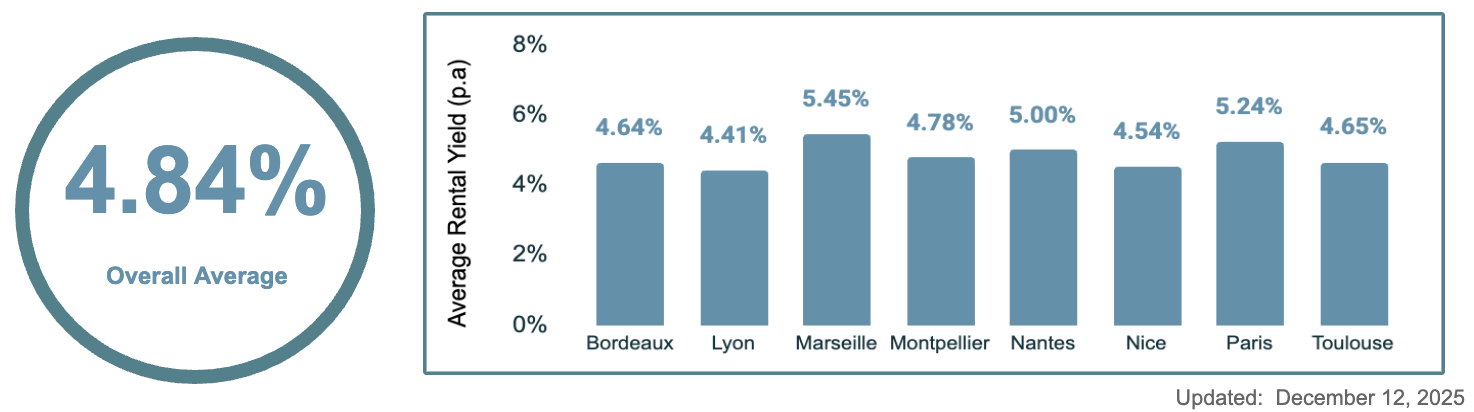
As of December 2025, average yields for one-bedroom apartments across France are as follows:
- Paris - 5.24%
- Marseille - 5.45%
- Nantes - 5.00%
- Montpellier - 4.78%
- Toulouse - 4.65%
- Bordeaux - 4.64%
- Nice - 4.54%
- Lyon - 4.41%
France's rent price index:
Data Source: OECD.
6. Market Performance (Past and Present)
France’s residential property market has shown steady long-term growth, though recent momentum has slowed. National price indexes report continued increases into 2025, but annual gains have been modest, and quarterly data show only slight nationwide growth. Real residential prices remain high relative to historical baselines, and nominal increases have exceeded inflation-adjusted gains over the past decade. The market has been less dynamic than in some other countries, with moderate price appreciation and notable regional differences between major cities and rural areas.
Recent performance has been characterized by price stabilization rather than rapid growth, reflecting a balanced market as supply constraints, affordability concerns, and economic uncertainty limit demand. Quarterly price growth remains positive but subdued, with house prices rising slightly in the latest data and forecasts indicating only modest annual increases through 2025. These trends suggest a shift toward a more measured market, where residential values remain high relative to historical averages but annual growth rates are lower than during previous periods of rapid expansion.
France's house price annual change:
Data Source: Institut National de la Statistique et des Études Économiques.
7. Landlord and Tenant Laws
France is pro-tenant, focusing on housing stability and affordability while maintaining essential landlord rights.
Rent is set at lease inception. In high-demand zones, known as zones tendues, rent controls apply, particularly in cities like Paris, Lyon, and Marseille. Rent increases for current tenants are typically allowed only at lease renewal and must comply with the government’s IRL index. Security deposits are limited to one month’s rent for unfurnished properties and two months for furnished units, with refunds due within two months of lease termination. Unfurnished leases generally have a minimum term of three years and provide greater tenant protections, while furnished leases usually last one year. Tenants may end leases with one to three months’ notice, depending on the property. Landlords must adhere to strict legal requirements regarding eviction and property standards. Tenants are usually required to obtain home insurance, and the rental agreement should clearly specify responsibilities for taxes and charges.
8. Property Related Taxes
France taxes non-residents only on income sourced in France. Individuals are generally subject to minimum income tax rates of 20% or 30%. Rental income is taxed at similar rates and is usually subject to additional social charges of 7.5% or 17.2%. Capital gains from property sales are taxed at 19%. However, long-term ownership can significantly reduce this liability, with full exemption possible after extended holding periods. Corporate income is taxed at a standard rate of 25%, with a reduced rate of 15% available for qualifying small companies. Property owners are also liable for annual holding taxes such as taxe foncière. High-value properties may be subject to wealth-based real estate taxes. Transaction costs on property purchases remain moderate.
Rental income from unfurnished properties is treated as regular taxable income after subtracting the landlord’s allowable expenses. These typically include mortgage interest, management fees, maintenance and repair costs, property taxes, and insurance.
9. Buying (and Selling) Costs
Round-trip transaction costs in France include notary fees, taxes, registration charges, and agent commissions. Newly built properties are subject to 20% VAT, while resale properties over five years old are exempt. Notary involvement is mandatory, with fees for new builds typically between 1.00% and 1.10% plus VAT. These frais de notaire cover transfer taxes, mortgage registration fees, and administrative formalities, most of which are regulated and non-negotiable. Land registry fees are generally about 0.10% of the property value. Real estate agent commissions usually range from 2.00% to 5.00% plus VAT, are often included in the advertised price (indicated as FAI), and may be shared between buyer and seller.
Here's a full breakdown:
| Transaction Costs | ||
| Who Pays? | ||
| Property Transfer Tax | 0.715% - 5.80% | buyer |
| Legal Fees | 1.00% - 1.50% | buyer |
| Notary Fees | 1.00% - 1.10% | buyer |
| Real Estate Agent Fee | 2.00% - 5.00% | seller |
| Costs Paid by Buyer | 2.715% - 8.40% | |
| Costs Paid by Seller | 2.00% - 5.00% | |
| Round-trip Transaction Costs | 4.715% - 13.40% | |
| Source: Global Property Guide, PWC | ||
10. Mortgage and Financing Options
Housing loan interest rates in France are stabilizing as the European Central Bank approaches the end of its easing cycle. Following several rate cuts since mid-2024, the ECB lowered its benchmark rates again in June 2025 and maintained them in July, citing reduced inflation and ongoing global uncertainty. As a result, the average interest rate on new housing loans in France was 3.00% in June 2025, slightly below earlier levels and under the eurozone average. Rates on outstanding loans were 1.89%, higher than a year ago but stabilizing. Most French mortgages are fixed-rate, while variable-rate loans account for a small share of the market.
Lower borrowing costs have boosted lending activity. In the first half of 2025, new housing loan production reached €88.03 billion, an increase of over 40% compared to the same period in 2024, though still below the 2021 peak. This recovery reflects improved credit conditions and stronger borrower demand. Outstanding housing loan volumes rose to €1.29 trillion by mid-2025, signaling a modest return to growth after two years of contraction. However, the mortgage market’s share of GDP continued to decline from its 2020 peak, reaching about 44.1% in 2024, while approximately 31% of French households have an outstanding housing loan.
France's mortgage loan interest rates:
Data Source: ECB.
Need Help?
Buying property in a foreign country can feel overwhelming, but we're here to help.
At Global Property Guide, we offer:
- Data-backed insights on property prices, rental yields, and taxes
- Country-specific legal and tax guidance through our partner network
- Pre-screened investment properties, including income-generating Airbnb units
- 1-on-1 consultations with real estate experts focused on international buyers
- Step-by-step buyer support, from due diligence to closing
Whether you're looking for your first investment in France or expanding your international portfolio, we can help you make smart, secure decisions.
Contact our team or book a free consultation to get started.